 Current Location:
Leaf Spring
Clutch Plate
Clutch Pressure Plate
Oil Filter
Battery Clamp
Motorcycle Parts
Hydraulic Fittings
Brake Rotor
Truck Leaf Spring
Product Details
Truck Leaf Spring Introduction
1. Basic Definition
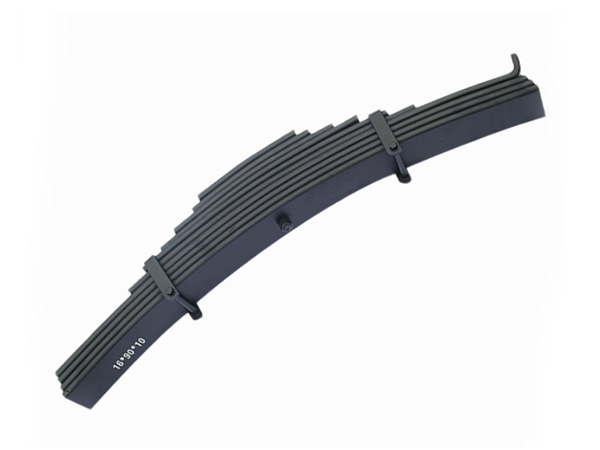
Truck leaf spring, also known as laminated spring or semi-elliptic spring, is one of the oldest and most widely used suspension components for heavy-duty trucks, trailers, buses and commercial vehicles. It consists of multiple layered, arc-shaped steel spring leaves stacked together, fixed by center bolts and side clips, connecting the vehicle frame and axles to bear loads and buffer road vibrations.
2. Core Structure
Spring Leaves: Graduated-length high-strength alloy steel plates. The longest main leaf has rolled eyes at both ends for pin connection with the frame hanger; shorter auxiliary leaves are layered underneath to boost load capacity.
Center Bolt: Runs through the middle of all leaves to lock each layer and prevent horizontal sliding during driving.
Spring Clips: Metal clamps fitted at intervals along the spring, keeping leaves tightly fitted when the spring compresses or stretches.
Shackles & Hangers: Mounting accessories at both ends, allowing slight length change of leaf springs under bump compression to ensure flexible shock absorption.
Rubber Bushings: Installed inside spring eyes to reduce metal friction noise and cushion impact.
3. Working Principle
When a truck travels over uneven roads, vertical impact force from wheels transmits to the leaf spring. The stacked steel plates bend and deform elastically to absorb vibration and shock. After the load disappears, the spring recovers its original arc shape, effectively isolating harsh road bumps from the cargo compartment and cab. Meanwhile, leaf springs bear vertical load, resist lateral sway and limit axle displacement, serving dual functions of shock absorption and load bearing.
4. Main Material & Production Standard
High-quality truck leaf springs adopt 51CrV4, 60Si2Mn alloy spring steel, featuring high tensile strength, excellent fatigue resistance and strong impact toughness. The manufacturing process strictly includes cutting, hot forming, quenching & tempering, shot peening and anti-rust coating:
Shot peening strengthens the leaf surface to extend service life against repeated bending fatigue;
Spraying epoxy paint or electrophoretic coating prevents rust under humid, muddy and corrosive road conditions.
5. Key Advantages for Commercial Trucks
Superior Load-bearing Capacity: Ideal for light, medium and heavy trucks carrying heavy cargo; customizable layers and thickness to match different tonnage demands.
Simple & Reliable Structure: Fewer precision parts compared with air suspension, low failure rate, easy on-site inspection, disassembly and maintenance.
Low Operation Cost: No air pumps, air bags or complex pneumatic control systems; replacement and repair costs are much lower.
Strong Structural Stability: Restricts axle movement effectively, improving vehicle stability during full-load transportation, climbing and heavy braking.
Wide Adaptability: Fits dump trucks, cargo trucks, tank trucks, semi-trailers, agricultural transport vehicles and engineering trucks.
6. Common Classification
By Shape: Semi-elliptic leaf spring (most mainstream), full-elliptic spring, cantilever leaf spring
By Load Grade: Light-duty (3–8 tons), medium-duty (10–20 tons), heavy-duty (25 tons and above)
By Usage: Front axle leaf spring, rear axle leaf spring, trailer leaf spring
7. Application Scenarios
Truck leaf springs are the preferred suspension solution for heavy commercial vehicles operating on mountain roads, construction sites, rural muddy roads and long-distance freight routes. They guarantee stable load support and durable shock absorption under harsh working conditions, protecting vehicle chassis, cargo and driving comfort.
8. Maintenance Tips
Regularly check loose center bolts, broken clips and cracked spring leaves;
Lubricate spring eye bushings and shackle joints to reduce abrasion;
Replace leaf springs immediately if permanent deformation, cracks or fracture appear to avoid axle deviation and traffic accidents.
BLOGS
-
How to Choose the Right Leaf Sp
2026-07-10 06:01:42Discover how to choose the right leaf spring for your heavy duty truck. Learn about load capacity, material types, and what to look for in a reliable leaf spring supplier....
MORE + -
Common Leaf Spring Problems and
2026-07-07 05:01:56Identify and resolve common leaf spring problems in fleet vehicles. Expert guide to diagnosing failures and implementing effective replacement solutions for commercial trucks....
MORE + -
Understanding Clutch Pressure P
2026-07-03 03:45:25Learn how the clutch pressure plate works and identify the signs that indicate it needs replacement. Expert guide for mechanics and vehicle owners on pressure plate diagnosis and selection....
MORE + -
Why do heavy vehicles need thic
2026-06-16 11:13:11Heavy-duty trucks, semi-trailer tractors and construction machinery operate under continuous high torque, heavy loads and frequent start-stop conditions, which generate severe mechanical pressure and thermal shock on clut...
MORE +