Current Location:
Common Leaf Spring Problems and Replacement Solutions for Fleet Vehicles
2026-07-07Fleet vehicles face a unique challenge: they must perform reliably across thousands of miles and hundreds of loading cycles while keeping operating costs predictable. Leaf spring failures are among the most disruptive suspension problems a fleet can encounter, often causing unplanned downtime, cargo delays, and safety concerns. Understanding the most common failure modes and their solutions is essential for fleet managers who want to minimize disruption and maintain safety standards.
Fatigue Cracking and Breakage
Fatigue cracking is the most prevalent cause of leaf spring failure in commercial vehicles. Unlike a sudden overload failure, fatigue cracks develop gradually over time as the spring is repeatedly loaded and unloaded. Each loading cycle causes microscopic damage that accumulates until a crack becomes visible and eventually propagates to the point of fracture.
Fatigue cracks typically originate at areas of stress concentration: the eyelet bore where the mounting bolt passes through, the rolled edges of parabolic springs, and the interface between leaves where they contact each other under load. Regular visual inspection is the primary defense against fatigue-related failures, as early-stage cracks can often be detected before complete breakage occurs.
When a leaf spring fails due to fatigue, the only effective solution is replacement. Attempting to repair a cracked spring through welding or reinforcement is not recommended, as the heat-affected zone created by welding will weaken the surrounding material and create new stress concentration points. Always replace with a spring that meets or exceeds the original specifications in terms of spring rate, material grade, and dimensional tolerances.
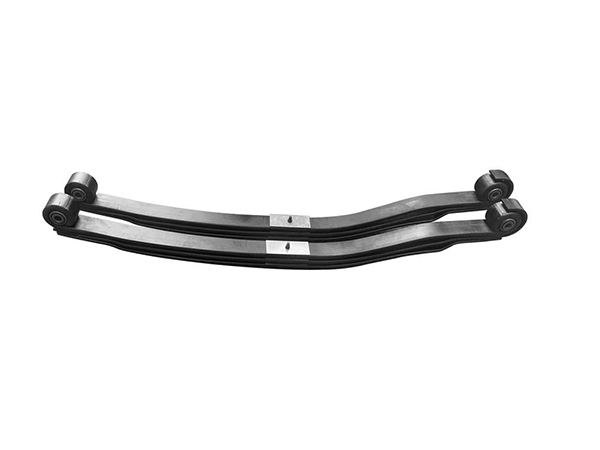
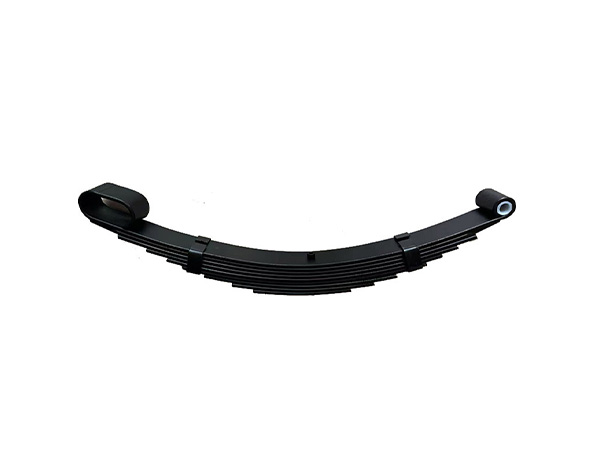
Excessive Sagging and Loss of Arch Height
Over time, even well-maintained leaf springs will lose some of their original free arch height. This phenomenon, known as spring sag, occurs as the material undergoes microstructural changes under repeated stress and the residual stresses from manufacturing gradually relax. While some sag is normal and expected over a long service life, excessive sag indicates that the spring has reached the end of its useful service life.
Excessive sag manifests as a lowered vehicle ride height, particularly at the rear axle. This creates several problems: the vehicle's headlight aim becomes incorrect, the rear suspension may bottom out more easily over bumps, and the overall handling characteristics change in ways that can affect driver comfort and vehicle stability. Load capacity is also reduced, as the spring's effective rate increases as it approaches a flat condition.
If only one spring on a vehicle shows excessive sag, it may indicate a localized problem such as a damaged bushing, misaligned mounting, or uneven loading pattern. A thorough inspection should determine whether the issue is systemic or isolated before proceeding with replacement.
Corrosion-Related Failures
Road salt, moisture, and chemical contaminants are particularly aggressive in the wheel well area where leaf springs are mounted. Corrosion attacks the spring steel from the surface inward, progressively reducing the effective cross-sectional area of each leaf. In severe cases, the corrosion rate can approach the point where the spring loses structural integrity even before the expected fatigue life is reached.
Galvanic corrosion can also occur at contact points between dissimilar metals within the spring assembly or between the spring and its mounting hardware. Applying dielectric washers or using properly isolated mounting systems can mitigate galvanic corrosion in susceptible applications.
For vehicles operating in corrosive environments, specifying springs with enhanced corrosion protection — such as hot-dip galvanizing, high-quality e-coating, or specialized anti-corrosion surface treatments — is a worthwhile investment that typically pays for itself through extended service intervals.
Loose or Failed Mounting Hardware
The spring assembly is only as reliable as its mounting system. Center bolts, eyelet pins, U-bolts, and rebound clips all play critical roles in maintaining the spring's position and alignment under load. Over time, these fasteners can loosen due to vibration, thermal cycling, and material compression at contact surfaces.
Loose mounting hardware is one of the most preventable causes of suspension-related failures. A simple torque check of all suspension fasteners at each major service interval will catch loose hardware before it causes a more serious problem. Any fastener that is found to be loose should be replaced, not reused, as the loosening event has likely damaged the fastener's locking features.
Choosing the Right Replacement Solution
When leaf spring replacement is necessary, fleet managers have several options: OEM replacement parts, equivalent aftermarket springs from a qualified supplier, or custom-engineered springs for specialized applications. The right choice depends on factors including vehicle age, usage profile, budget constraints, and whether the vehicle is still in OEM production.
A quality aftermarket supplier can often provide springs that meet or exceed OEM specifications at a more competitive price. Look for suppliers who offer comprehensive technical documentation, material certifications, and batch testing capabilities. The ability to source custom springs for non-standard applications is also valuable for fleets operating older or customized vehicles.
Conclusion
Leaf spring problems in fleet vehicles are best addressed through a combination of regular inspection, proactive replacement, and sourcing quality components from established manufacturers. Catching problems early through routine maintenance not only prevents breakdowns but also extends the overall service life of the suspension system.
References
Society of Automotive Engineers. (2022). SAE J1211: Recommended Practice for Optimizing Vehicle Suspension Systems. SAE International, Warrendale, PA.
American Association of State Highway and Transportation Officials. (2020). AASHTO Guide for Maintenance of Transportation Fleet Equipment. AASHTO, Washington, D.C.
Collins, J.A. (1993). Failure of Materials in Mechanical Design (2nd ed.). John Wiley & Sons, New York. — Chapter 7: Fatigue Failure of Spring Components.
National Safety Council. (2021). Fleet Safety Management: Inspection and Maintenance Protocols. Itasca, IL.