 Current Location:
Leaf Spring
Clutch Plate
Clutch Pressure Plate
Oil Filter
Battery Clamp
Motorcycle Parts
Hydraulic Fittings
Brake Rotor
Rear Axle Leaf Spring
Product Details
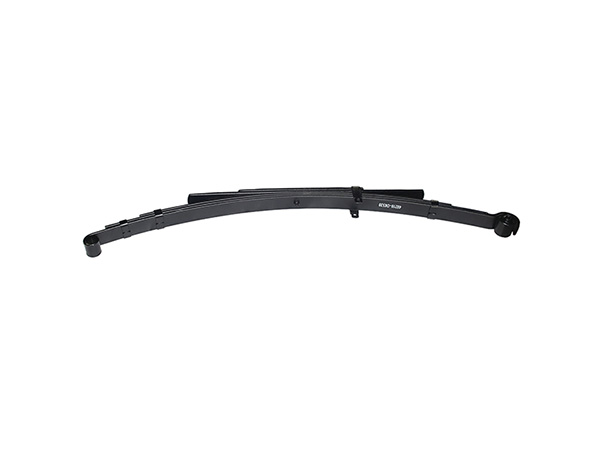
Rear axle leaf spring is a dedicated suspension component exclusively mounted on the vehicle rear axle, widely fitted to trucks, pickup trucks, commercial trailers and light-duty engineering vehicles. As the primary load-bearing and shock-absorbing unit of the rear suspension system, it bridges the vehicle frame and rear axle, undertaking most of the vehicle’s cargo load, towing pressure and road vibration impact. Unlike front axle springs focused mainly on shock buffering, rear axle leaf springs are structurally optimized for heavy-load resistance and driving stability, making them a core guarantee for vehicle load capacity and safe transportation.
The assembly structure of rear axle leaf spring is precise and practical, consisting of main leaf, auxiliary gradient leaves, center bolt, fixed spring clips, rubber bushings and interlayer anti-wear gaskets. The extended main leaf with rolled eyes at both ends acts as the main stress body, stably connecting with the frame shackles to ensure flexible telescopic movement during driving. The matched multi-layer auxiliary leaves gradually increase structural stiffness, effectively improving the overall load-bearing limit of the spring pack. The center bolt locks all steel plates integrally to avoid layer sliding and dislocation under heavy load, while multiple spring clips prevent leaf separation during compression and rebound. Auxiliary rubber accessories reduce metal friction noise and wear, greatly extending the service life of the rear suspension assembly.
Its working principle relies on the elastic deformation characteristics of high-strength steel. When the vehicle is loaded or travels on bumpy, uneven roads, road vibration and vertical impact are transmitted to the rear axle and concentrated on the leaf spring pack. The layered steel plates bend and deform elastically to absorb impact energy and buffer road jolts, isolating vibration from the carriage and cargo. After the external load disappears, the spring automatically rebounds to its original standard camber. In addition to basic shock absorption, the rear axle leaf spring effectively limits rear axle displacement, suppresses body roll during cornering, controls axle wrap during acceleration, and avoids rear-end floating during braking, significantly improving the overall driving controllability and stability of loaded vehicles.
High-performance rear axle leaf springs adopt high-quality 60Si2Mn and 51CrV4 alloy spring steel as raw materials, which feature ultra-high tensile strength, excellent bending fatigue resistance and strong impact toughness, adapting to long-term heavy-load operation. The manufacturing process follows strict automotive industry standards, including precision cutting, hot bending forming, camber calibration, integral quenching and tempering heat treatment, surface shot peening and multi-layer anti-corrosion coating. Heat treatment stabilizes the internal metal structure to ensure lasting elasticity, while shot peening eliminates surface stress concentration and resists fatigue fracture. Electrophoretic and epoxy coating layers effectively resist rust, salt spray and mud corrosion, adapting to complex road and harsh weather conditions.
Rear axle leaf springs are mainly divided into standard multi-leaf type and parabolic tapered type. The multi-leaf structure has high rigidity and super load-bearing capacity, suitable for heavy-duty trucks, cargo trailers and engineering vehicles with frequent heavy-load transportation. The parabolic leaf spring features variable-thickness tapered design, reducing interlayer friction and overall weight, delivering smoother riding comfort, and is mostly used for light pickups and daily commercial transport vehicles. All specifications support customized size, arch height and leaf quantity to match OEM replacement and aftermarket modification needs.
Compared with other suspension structures, rear axle leaf springs have outstanding advantages of simple and sturdy structure, low failure rate, convenient installation and low maintenance cost. They can maintain stable working performance under long-term heavy load, bumpy road driving and frequent start-stop conditions. As the most reliable core part of rear suspension system, rear axle leaf springs effectively protect the rear axle chassis and cargo safety, and have become the mainstream preferred suspension accessory for various commercial vehicles and transport equipment worldwide.
BLOGS
-
How to Choose the Right Leaf Sp
2026-07-10 06:01:42Discover how to choose the right leaf spring for your heavy duty truck. Learn about load capacity, material types, and what to look for in a reliable leaf spring supplier....
MORE + -
Common Leaf Spring Problems and
2026-07-07 05:01:56Identify and resolve common leaf spring problems in fleet vehicles. Expert guide to diagnosing failures and implementing effective replacement solutions for commercial trucks....
MORE + -
Understanding Clutch Pressure P
2026-07-03 03:45:25Learn how the clutch pressure plate works and identify the signs that indicate it needs replacement. Expert guide for mechanics and vehicle owners on pressure plate diagnosis and selection....
MORE + -
Why do heavy vehicles need thic
2026-06-16 11:13:11Heavy-duty trucks, semi-trailer tractors and construction machinery operate under continuous high torque, heavy loads and frequent start-stop conditions, which generate severe mechanical pressure and thermal shock on clut...
MORE +