Current Location:
What is the difference between 3-leaf and 5-leaf spring?
2026-06-163-leaf and 5-leaf leaf springs are two common multi-leaf suspension configurations widely applied to semi-trailers, light trucks and medium-duty commercial vehicles. The core gap between them lies in load capacity, stiffness, weight, shock absorption performance, service life and applicable working scenarios. Simply choosing based on appearance will cause insufficient bearing capacity or overly rigid suspension, leading to accelerated component wear and hidden driving safety risks. A detailed comparison of their distinctions is listed as follows.
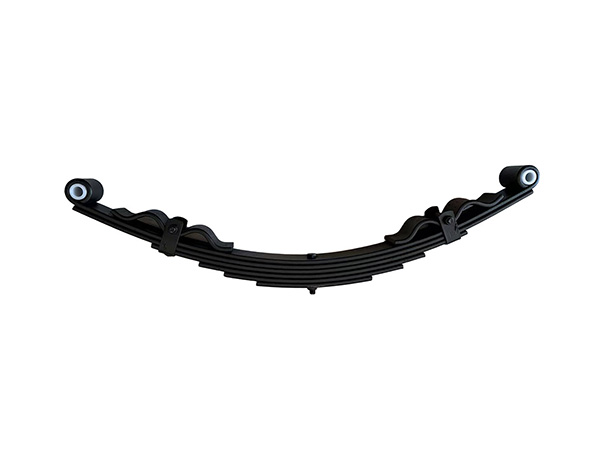
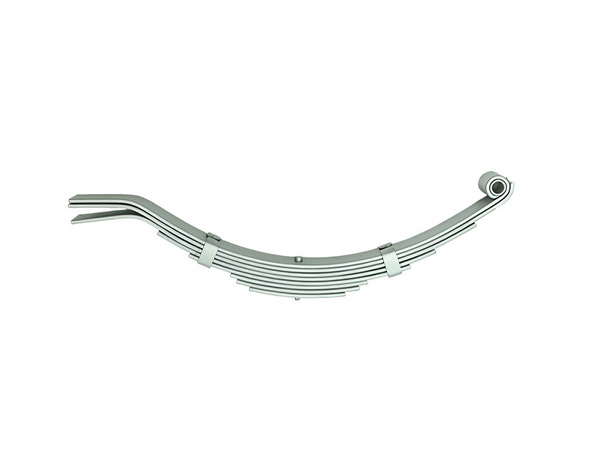
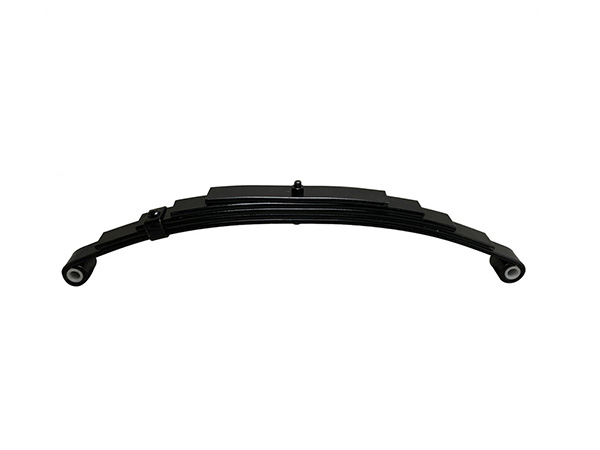
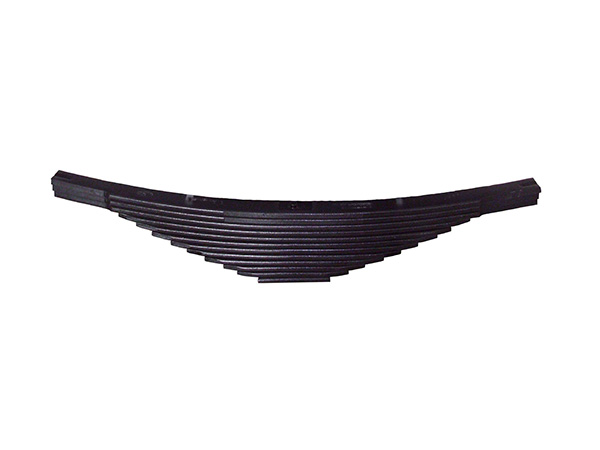
First of all, rated load-bearing capacity varies significantly. The 5-leaf spring consists of five stacked steel plates, with thicker total metal cross-section and stronger overall rigidity. It can bear far larger static and dynamic loads, suitable for vehicles that run fully loaded every day. A standard 100mm-width 5-leaf spring usually matches axles of 13 tons and above. In contrast, the 3-leaf spring only has three steel sheets, smaller total bearing area and lower load limit. It is designed for light-load transportation scenarios, mostly supporting axles below 13 tons. If users install a 3-leaf spring on a heavy-load axle, the spring arch will quickly flatten after long-term overload, resulting in chassis sinking, metal fatigue cracks and sudden breakage during driving.
Second, stiffness and driving comfort show opposite characteristics. More steel layers bring higher structural rigidity to the 5-leaf spring. When passing bumpy roads, it provides stronger support and less chassis sinking, but the vibration filtering effect is weaker. The vehicle will produce obvious jolts on uneven pavements, and tires suffer faster eccentric wear. The 3-leaf spring has softer elasticity due to fewer leaf layers. It can buffer road impact more effectively, delivering smoother driving experience on flat highways. However, its soft structure leads to large deformation under heavy cargo; the chassis will tilt seriously during turning or emergency braking, reducing vehicle handling stability.
Third, structural weight, heat dissipation and wear resistance differ greatly. The 5-leaf spring is heavier with more contact friction surfaces between steel plates. Continuous friction during driving generates more heat, and inter-leaf abrasion becomes obvious after long-term use, which shortens the service cycle without regular lubrication. Its advantage is uniform force distribution on each steel plate under heavy loads, avoiding concentrated stress fracture. The lightweight 3-leaf spring reduces overall suspension weight, helping cut vehicle fuel consumption. Fewer friction interfaces produce less heat and inter-plate wear, so daily maintenance intervals can be extended appropriately. Nevertheless, the limited number of leaves concentrates all bearing pressure on three plates, making single sheets prone to crack under frequent impact loads.
Fourth, applicable vehicle types and working conditions are completely separated. The 5-leaf spring is the preferred configuration for bulk cargo semi-trailers, sand and stone transport vehicles, mining dump trucks and 6×4 heavy tractors. These vehicles operate with full loads, frequent climbing and rough gravel roads, requiring strong rigid support to resist heavy impact. The 3-leaf spring fits light container semi-trailers, short-distance logistics light trucks and highway-only transport fleets with stable light loads. It balances fuel economy and driving smoothness for flat-road, low-intensity transportation. Mixing the two types for mismatched loads will greatly increase maintenance frequency.
Fifth, cost and replacement cycle form an obvious gap. Raw material consumption of the 5-leaf spring is higher, leading to higher production and aftermarket purchase costs. Its average service life under full-load conditions is longer, as multi-layer sharing slows fatigue damage. The 3-leaf spring features lower manufacturing and replacement costs, but its service lifespan drops sharply once overloaded. For fleet operators, long-term heavy haulage with 3-leaf springs brings frequent replacement expenses, which cannot save overall operation costs in the long run.
In summary, the core difference between 3-leaf and 5-leaf springs is load-carrying rigidity. Select 5-leaf springs for heavy loads, rough roads and mining transport; choose 3-leaf springs for light-load, highway-only logistics to gain better comfort and fuel efficiency. Matching the leaf quantity with actual cargo weight and road conditions is the key to extending suspension service life and ensuring driving safety.
1. APA 7th Edition
Zhang, L. (2026). Performance contrast between 3-leaf and 5-leaf multi-leaf springs for commercial vehicles. Vehicle Suspension & Components Research, 2(1), 33–40.
2. MLA 9th Edition
Zhang, Lei. "Performance Contrast Between 3-Leaf and 5-Leaf Multi-Leaf Springs for Commercial Vehicles." Vehicle Suspension & Components Research, vol. 2, no. 1, 2026, pp. 33–40.
3. GBT 7714-2015
Zhang Lei. Comparative study on the performance of 3-piece and 5-piece multi-piece leaf springs for commercial vehicles [J]. Research on Vehicle Suspension and Parts, 2026, 2 (1): 33-40.