Current Location:
Leaf Springs for Agricultural Machinery and Tractors
2026-10-13Agricultural machinery lives a harder life than almost any road vehicle. It works in dust, mud, manure, and fertilizer; it carries irregular loads; and it spends its off-season parked in a field. The suspension components on tractors, trailers, and implements take the brunt of this environment, and leaf springs remain the default choice across most farm equipment for one simple reason: they keep working when more delicate systems would not.
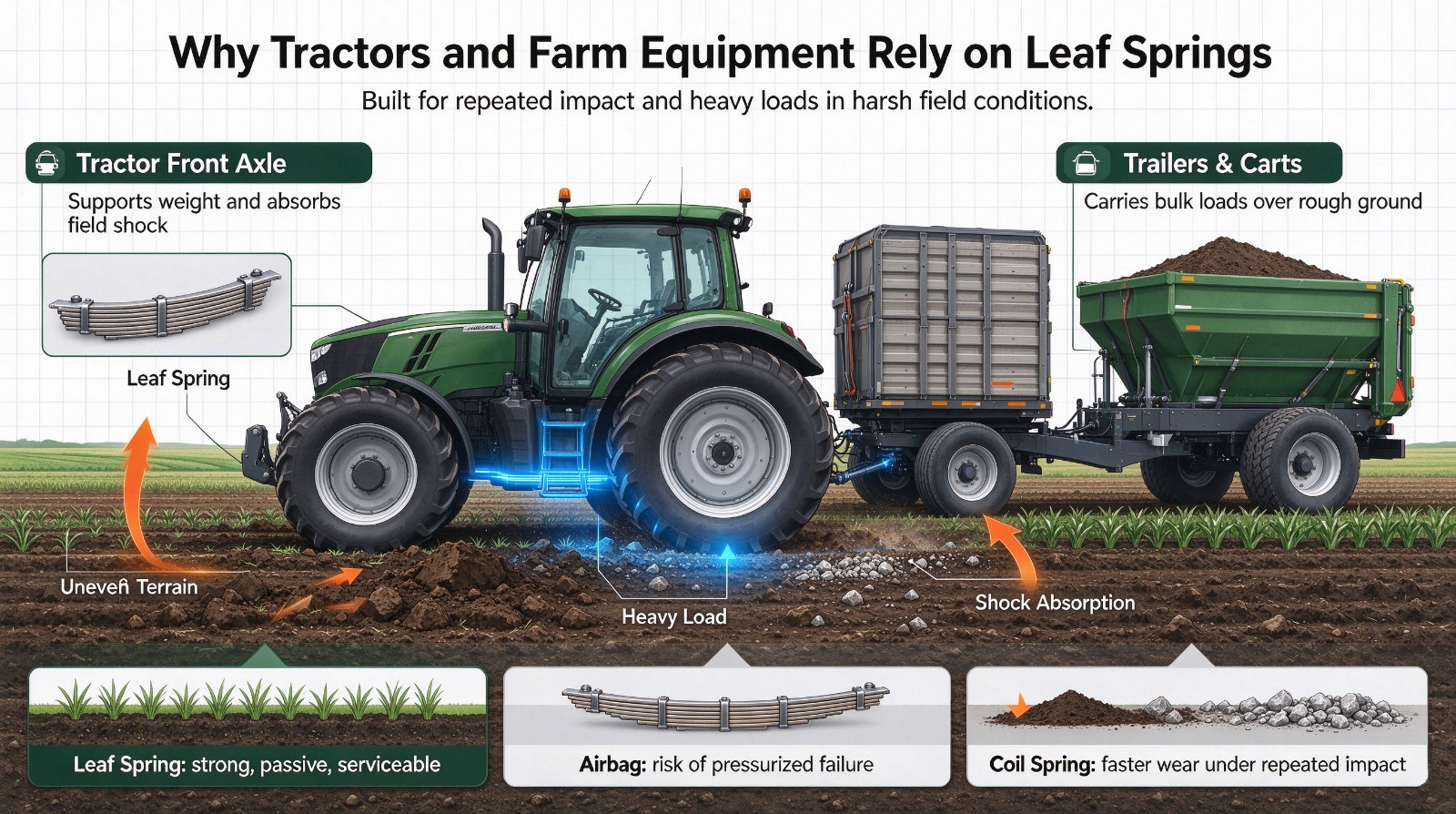
Why Tractors and Farm Equipment Rely on Leaf Springs
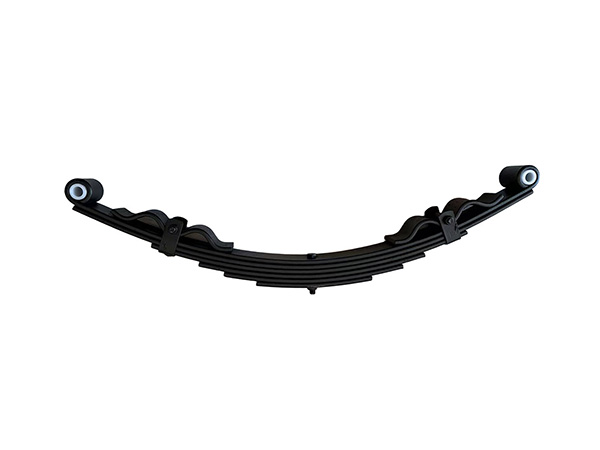
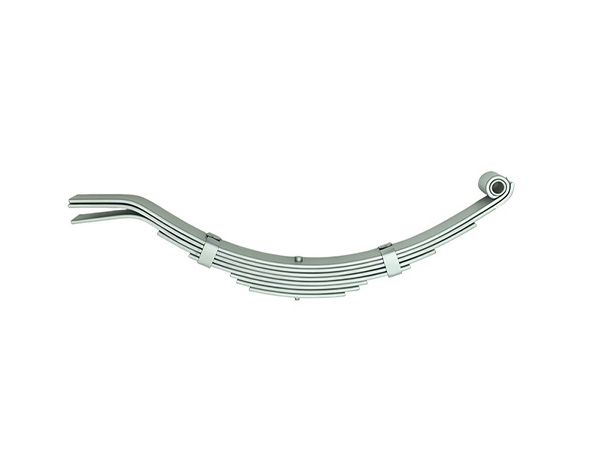
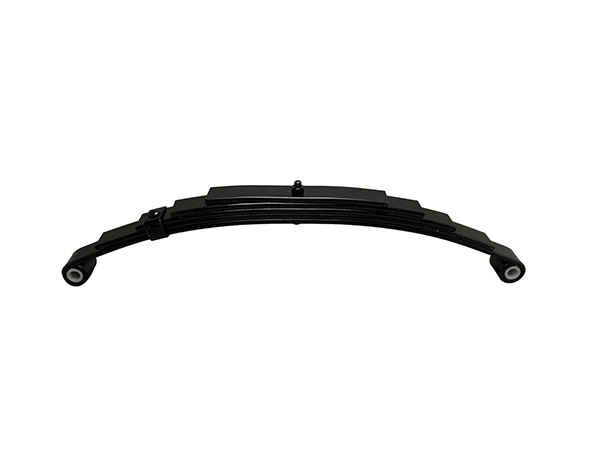
Farm equipment spans two suspension needs. The tractor itself often uses leaf springs on the front axle to support weight and absorb field shock, while tractors, trailers, and seed or fertilizer carts use them to carry bulk loads over rough ground. In both roles, the spring must survive repeated impact from ruts, rocks, and uneven terrain that would quickly destroy airbags or coil springs.
The passive nature of a leaf spring is an asset here. There is nothing to pressurize, no sensor to misread, and no electronic control to fail when the operator is miles from a workshop.
Load Profiles in Agricultural Work
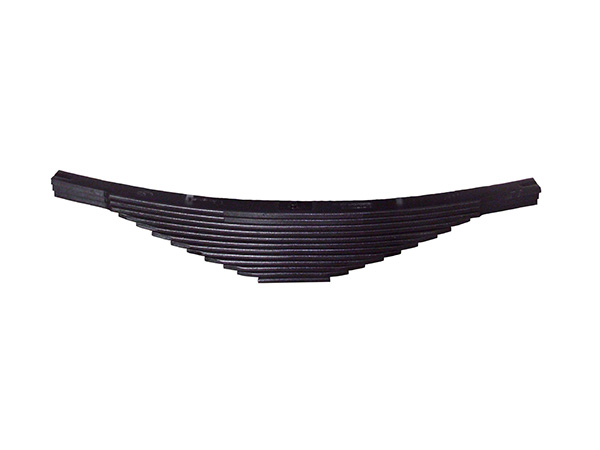
Agricultural loads are rarely steady. A fertilizer spreader might run empty to the field and return full, or a trailer might carry a concentrated load of harvested crop that shifts as it unloads. Leaf springs handle this variability well, particularly progressive-rate designs that stay compliant under light loads and firm under heavy ones.
Because farm equipment axles see both vertical impact and substantial lateral force from steering on soft ground, the spring and its mounting must be specified with margin. Undersized springs on a loader tractor will sag and contact the axle stops far sooner than expected.
Corrosion Challenges on the Farm
No environment is harder on steel than a working farm. Fertilizer salts, lime, and manure are aggressively corrosive, and equipment is routinely washed with high-pressure water that drives moisture into every crevice. A standard painted spring can lose thickness at the leaf edges within a couple of seasons.
For this reason, agricultural springs benefit from heavy corrosion protection — galvanizing, thick e-coating, or periodic undercoating. Specifying the right protection up front is cheaper than replacing rusted springs after they have thinned to the point of cracking.
Custom Spring Rates for Implements
Off-the-shelf springs rarely fit a custom-built implement or a modified older machine. Implements such as hay racks, sprayer tenders, and grain carts may need a specific arch, eye configuration, or rate that only a custom spring delivers. A manufacturer able to build to a drawing or a sample — reproducing an obsolete spring or designing a new one for a novel axle — is valuable to equipment builders and restoration shops alike.
The benefit of custom work is not only fit but also lifecycle: a spring built for the actual load carries it without premature fatigue, avoiding the premature failures that come from forcing a generic part into service.
Sourcing from an Agricultural Parts Manufacturer
When buying springs for farm equipment, look for a manufacturer familiar with off-road and agricultural duty cycles, not just on-road truck springs. The difference shows up in coating choices, leaf thickness margins, and the willingness to produce small custom batches. A supplier that supports OEM and ODM work and can match historical dimensions helps keep older machinery productive long after the original parts are unavailable.
Closing Thoughts
Leaf springs suit agricultural machinery because they match the environment: tough, simple, and tolerant of abuse. Specifying the right rate, protecting against the farm's corrosion load, and having a manufacturer that can supply both standard and custom springs keeps equipment in the field where it earns its keep.
References
American Society of Agricultural and Biological Engineers. (2017). ASABE Standards: Agricultural Machinery Safety and Design. ASABE, St. Joseph, MI.
SAE International. (2021). SAE J1123: Recommended Practice for Vehicle Suspension Springs. SAE International, Warrendale, PA.
Reimpell, J., Stoll, H., & Betzler, J.W. (2001). The Automotive Chassis: Engineering Principles (2nd ed.). Butterworth-Heinemann, Oxford.
Gillespie, T.D. (1992). Fundamentals of Vehicle Dynamics. SAE International, Warrendale, PA.