Current Location:
Heavy Duty Truck Clutch Disc: Torque Capacity and Selection
2026-10-13Heavy duty trucks ask more of a clutch than any other vehicle class. Engine torque figures have climbed steadily, and a disc that was adequate a decade ago can be marginal today. Selecting the right heavy duty clutch disc is fundamentally a torque problem: the disc must transmit the engine's output indefinitely without slipping, while still engaging smoothly enough for a driver shifting all day. Getting this wrong is the fastest route to a clutch that burns out before its time.
Understanding Torque Capacity Ratings
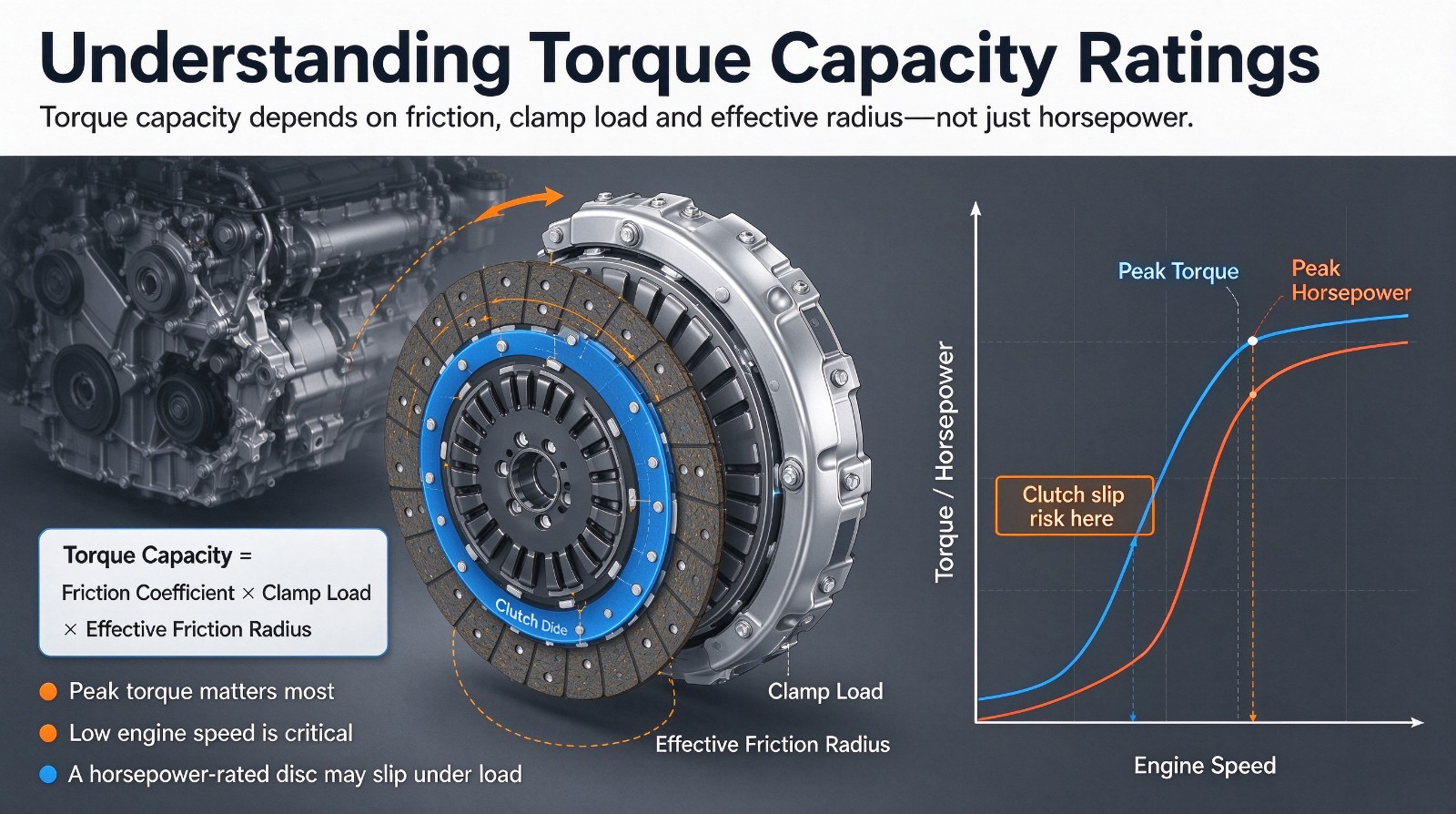
A clutch disc's torque capacity is the maximum engine torque it can transmit without slip, and it is determined by the friction coefficient, the clamp load from the pressure plate, and the effective friction radius. Manufacturers publish a rating, but the number only means something against your actual engine torque curve, not the brochure figure alone.
The relevant value is peak torque, not peak horsepower, because clutch slip happens at low engine speed where torque is highest. A disc rated for horsepower but marginal on torque will slip the moment the driver lugs the engine in a high gear.
Matching the Disc to Engine Output
The standard practice is to select a disc with torque capacity comfortably above the engine's peak torque — commonly a 30 to 50 percent margin for heavy duty service, because the disc also sees shock loads from gear changes, grade changes, and irregular cargo. A tighter margin leaves no buffer for a tired pressure plate or a hot, glazed surface.
When upgrading an engine or fitting a higher-output unit, the original clutch is almost never sufficient. The disc, and often the pressure plate, must be uprated to match the new torque, not carried over on hope.
Organic vs Ceramic for Heavy Duty
For heavy duty trucks, the friction material choice is between upgraded organic compounds and ceramic. Heavy duty organic discs offer good pedal feel and flywheel-friendly engagement but fade under sustained heat. Ceramic discs withstand far higher temperatures and resist fade, making them the default for severe-duty hauling, but they engage more abruptly and wear the flywheel faster.
The decision rests on duty cycle. Trucks that run fully loaded in hilly terrain or in stop-start urban delivery benefit from ceramic's heat tolerance. Those on steady highway runs at moderate load may do fine on a heavy duty organic compound with a smoother feel.
Dual-Plate Options for High Torque
When a single disc cannot carry the torque within a reasonable diameter, dual-plate clutches stack two discs between the flywheel and a floating intermediate plate, roughly doubling torque capacity for the same clamp load. They are common in the highest-output trucks and in some performance applications where space limits disc diameter.
Dual-plate units are more complex and sensitive to setup, so they should be specified only when a single plate truly cannot meet the requirement, and always with matched components from a manufacturer that understands the configuration.
Sourcing Heavy Duty Discs from a Manufacturer
For commercial buyers, the sourcing decision should weigh rated torque, friction material, and the supplier's ability to document the specification. A manufacturer that provides torque ratings tied to specific engine applications, and that can supply heavy duty variants or custom discs for unusual transmissions, removes much of the risk of a mismatch.
Consistency across batches also matters for fleets: every disc should perform like the validated sample. A manufacturer with disciplined process control and application engineering is worth more than the lowest price on a part whose real rating is uncertain.
Closing Thoughts
Selecting a heavy duty truck clutch disc is an exercise in matching torque capacity to real engine output with margin to spare, then choosing a friction material suited to the duty cycle. Done well, the clutch disappears into reliable service; done poorly, it becomes a recurring failure. Sourcing from a manufacturer that can specify, document, and consistently supply the right disc is the foundation of that reliability.
References
Society of Automotive Engineers. (2020). SAE J2487: Automotive Clutch Test Procedures and Performance Evaluation. SAE International, Warrendale, PA.
Naunheimer, H., Bertsche, B., Ryborz, J., & Novak, W. (2011). Automotive Transmissions: Fundamentals, Selection, Design and Application (2nd ed.). Springer, Berlin.
Erjavec, J. (2019). Manual Transmissions: Transaxles, Service and Repair. Cengage Learning, Boston, MA.
Wahl, R. (2015). Automotive Clutch Technology: Friction Materials and Thermal Management. SAE Technical Paper Series. doi:10.4271/2015-01-2739.