Current Location:
U-Bolts and Mounting Hardware: The Safety Link in Every Leaf Spring
2026-10-13The leaf spring gets the glory, but the U-bolts holding it to the axle do the real heavy lifting. These unassuming threaded rods carry the entire clamp load that keeps the spring seated on the axle. When they fail, the consequences are not a rough ride — they are a detached axle. For that reason, anyone responsible for fleet safety should treat suspension fasteners as safety-critical parts, not consumables.
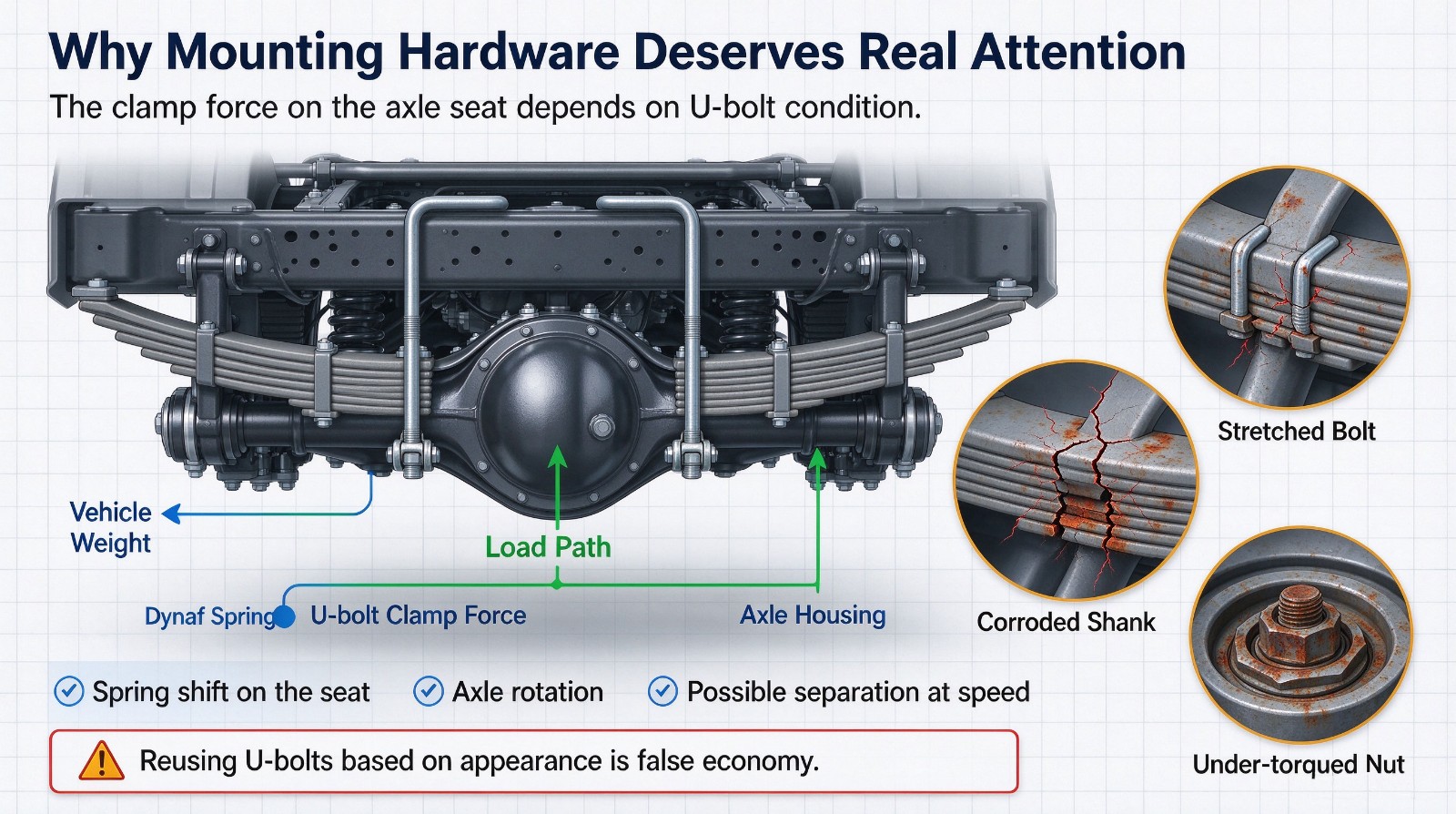
Why Mounting Hardware Deserves Real Attention
A leaf spring transmits the vehicle's weight and the dynamic forces of cornering and braking into the axle. That load path depends entirely on the U-bolts maintaining clamp force on the axle seat. If the bolts stretch, corrode, or are under-torqued, the spring can shift on the seat, the axle can rotate, and at worst the assembly can separate. None of that is recoverable at speed.
Despite this, U-bolts are among the most commonly reused parts during spring jobs, usually on the logic that they "look fine." They rarely look broken, but they may already be past their safe working life.
U-Bolt Grades and Material Specs
U-bolts for suspension use are made from high-tensile steel, commonly Grade 8 or the metric equivalent, with a defined proof load and tensile strength. The bends are formed before heat treatment so the material around the radius keeps its strength. A bolt bent after hardening would be a stress riser waiting to crack.
Buyers should ask for the material specification and grade marking. Reputable suppliers mark their fasteners; unmarked bolts of unknown origin have no place in a suspension. For corrosive environments, zinc or galvanized coatings extend service life, though the coating should not be relied on to carry load.
Center Bolts and Rebound Clips
Beyond the U-bolts, two smaller parts keep the spring honest. The center bolt ties the leaf pack together and locates it on the axle, while rebound clips stop the leaves from separating when the axle drops during rebound. Neither is structural in the sense of carrying vehicle weight directly, but both prevent the leaves from walking out of position. A missing or loose center bolt lets the pack twist, which is a fast track to uneven wear and noise.
Correct Torque and Re-Torque Intervals
U-bolts must be torqued to the figure specified for the diameter and grade, and they must be re-torqued after the spring settles. New leaves bed in over the first stretch of driving, which relaxes the clamp load, and a single torque at installation is not enough. Best practice is to re-check at 50 miles, again at 500, and at each scheduled service for the first few intervals.
Always torque with the suspension at its normal ride height, meaning the vehicle's weight should be on the wheels, not hanging from a lift. Torquing a drooping suspension then lowering the truck will leave the bolts under-stressed and the spring able to shift.
Corrosion and Hardware Failure
Road salt and moisture attack suspension fasteners relentlessly. A bolt that looks solid from the outside can be corroded through at the threads under the nut, where it is hidden. Once corrosion pits the thread, the clamp load it can hold drops sharply. In northern climates or coastal operations, inspecting and replacing hardware on a schedule is far cheaper than recovering a failed axle.
Sourcing Reliable Hardware from a Supplier
A suspension hardware supplier should provide grade markings, material certifications, and the correct nut and washer for each bolt. For fleet buyers, sourcing U-bolts cut and bent to the exact axle diameter and spring width — rather than adapting a generic size — guarantees a proper seat and even load distribution. A manufacturer that tracks batch consistency also means every box of bolts matches the last, which matters when you are fitting dozens of vehicles.
Closing Thoughts
The U-bolt is the cheapest part of the suspension and the most dangerous to neglect. Specifying the right grade, torquing it correctly with the suspension loaded, and re-torquing after bedding-in is a small discipline that prevents the worst-case failure. Pairing new springs with fresh, certified hardware from a dependable supplier is simply the professional way to do the job.
References
SAE International. (2018). SAE J429: Mechanical and Material Requirements for Externally Threaded Fasteners. SAE International, Warrendale, PA.
American Society of Mechanical Engineers. (2017). ASME B18.2.1: Square and Hex Bolts and Screws. ASME, New York.
Federal Motor Carrier Safety Administration. (2019). Commercial Motor Vehicle Inspection and Maintenance Standards. U.S. DOT, Washington, D.C.
Bickford, J.H. (2008). An Introduction to the Design and Behavior of Bolted Joints (4th ed.). CRC Press, Boca Raton, FL.