 Current Location:
Leaf Spring
Clutch Plate
Clutch Pressure Plate
Oil Filter
Battery Clamp
Motorcycle Parts
Hydraulic Fittings
Brake Rotor
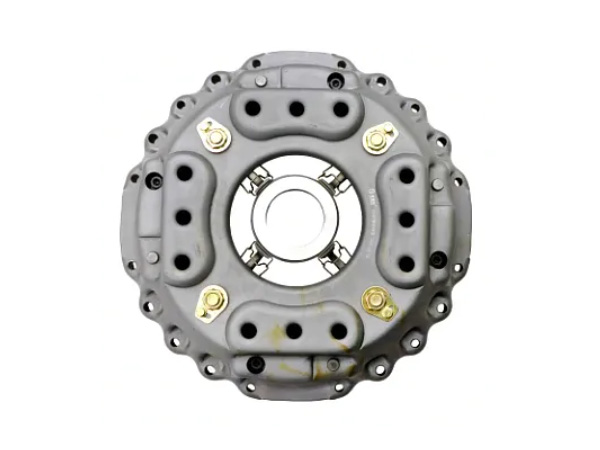
430 Clutch Pressure Plate
Product Details
Measuring 430 mm in friction outer diameter, the 430 clutch pressure plate is a heavy-duty clutch cover assembly specially designed for high-torque heavy commercial vehicles. It is an indispensable core part of the dry clutch system, cooperating with clutch disc, flywheel and release bearing to control power connection and disconnection between engine and transmission. Compared with smaller 380, 400 and 420 clutch pressure plates, the 430 mm model boasts expanded friction contact area, enhanced clamping force and outstanding heat dissipation capacity. It is widely matched with high-horsepower tractors, full-load dump trucks, long-distance coaches and engineering transport vehicles. In high-intensity working conditions such as mountain climbing, overloaded cargo delivery and frequent start-stop, it can effectively prevent clutch slip, friction plate burning and pressure plate thermal deformation, securing stable power output for heavy vehicles.
Product Structure
A complete 430 clutch pressure plate assembly consists of clutch cover, cast iron pressure plate, diaphragm spring, transmission steel strips and high-strength rivets. Each component undergoes fine machining to guarantee matching precision and durability.
The clutch cover adopts thickened integral stamped steel, with reinforced surrounding ribs to boost structural rigidity and resist deformation under long-term high temperature. The pressure plate friction surface is made of high-density wear-resistant cast iron, processed by precision surface grinding to achieve flat finish, ensuring uniform contact with the clutch disc and avoiding partial eccentric wear. The diaphragm spring, made of premium chromium-vanadium spring steel, serves as the source of clamping force. Both push-type and pull-type structures are available to fit Chinese, European and American heavy truck models. Flexible transmission strips connect the cover and pressure plate into a whole, realizing synchronous movement during separation and combination without stuck or delayed response. All rivets receive anti-vibration and anti-loose treatment to adapt to bumpy long-distance driving.
How It Works
When the clutch pedal is released, the diaphragm spring recovers its natural curved shape and produces even axial pressure, firmly clamping the clutch disc between pressure plate and flywheel. The friction force transfers full engine torque to the gearbox to drive vehicle movement. When the driver depresses the clutch pedal, the release bearing pushes the spring fingers of the diaphragm spring, altering its radian and lifting the pressure plate away from the friction disc. The power transmission path is disconnected, enabling smooth gear shifting without hard impact on gear teeth. Thanks to its large 430 mm friction surface, pressure and heat are evenly distributed during engagement, lowering local overheating risk and greatly extending the service cycle of the whole clutch set.
Material & Manufacturing Craft
All raw materials comply with IATF16949 automotive industry quality standards. The clutch cover uses impact-resistant low-alloy steel; the pressure plate applies thermally stable special cast iron; the diaphragm spring adopts 51CrV4 spring steel with excellent anti-fatigue property.
Standard production procedures include numerical cutting, hot forming, stress relief annealing, precision grinding, component assembly, dynamic balance test, electrophoretic anti-rust coating and 90% finished product performance inspection. Shot peening is applied on diaphragm springs to eliminate internal stress and prevent fatigue cracks after millions of repeated compressions. Multi-layer anti-corrosion coating protects the assembly from erosion caused by rain, mud, snow and road salt spray.
Core Strengths
First, it supports ultra-high torque transmission, perfectly meeting the demand of full-load heavy haulage without power slip. Second, its excellent heat dispersion performance effectively stabilizes operating temperature and reduces clutch failure frequency. Third, optimized spring elasticity delivers moderate pedal effort, smooth separation and gentle engagement to upgrade driving comfort. Fourth, reinforced construction improves fatigue resistance and lowers vehicle fleet maintenance expenditure. Fifth, customizable mounting dimensions and spring types support OEM original matching and aftermarket replacement for Sinotruk, Shacman, FAW, Volvo, Scania and other mainstream vehicle brands.
Application Fields
This 430 clutch pressure plate is extensively used in container semi-trailers, mining dumpers, intercity passenger buses, heavy farm transport vehicles and construction machinery carriers. It acts as a trustworthy replacement spare part for auto repair shops, logistics fleets and machinery maintenance suppliers, maintaining consistent and reliable power transmission performance under all severe heavy-duty operation environments.
BLOGS
-
How to Choose the Right Leaf Sp
2026-07-10 06:01:42Discover how to choose the right leaf spring for your heavy duty truck. Learn about load capacity, material types, and what to look for in a reliable leaf spring supplier....
MORE + -
Common Leaf Spring Problems and
2026-07-07 05:01:56Identify and resolve common leaf spring problems in fleet vehicles. Expert guide to diagnosing failures and implementing effective replacement solutions for commercial trucks....
MORE + -
Understanding Clutch Pressure P
2026-07-03 03:45:25Learn how the clutch pressure plate works and identify the signs that indicate it needs replacement. Expert guide for mechanics and vehicle owners on pressure plate diagnosis and selection....
MORE + -
Why do heavy vehicles need thic
2026-06-16 11:13:11Heavy-duty trucks, semi-trailer tractors and construction machinery operate under continuous high torque, heavy loads and frequent start-stop conditions, which generate severe mechanical pressure and thermal shock on clut...
MORE +