 Current Location:
Leaf Spring
Clutch Plate
Clutch Pressure Plate
Oil Filter
Battery Clamp
Motorcycle Parts
Hydraulic Fittings
Brake Rotor
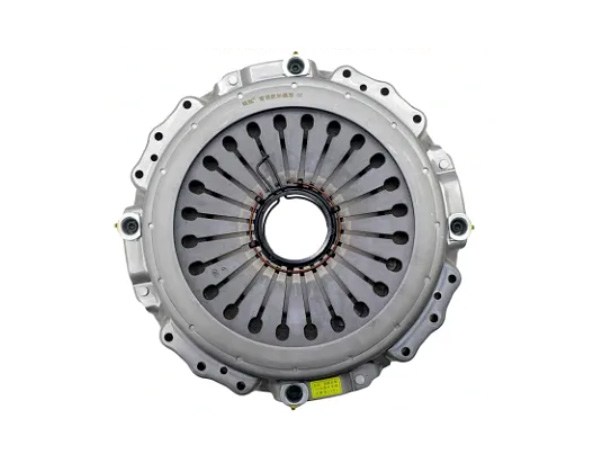
430 Clutch Pressure Plate
Product Details
Defined by its 430mm friction diameter, the 430 clutch pressure plate is a heavy-duty clutch cover assembly built exclusively for high-torque commercial vehicles and heavy engineering transport equipment. As a central part of dry clutch systems, it collaborates with flywheel, clutch disc and release bearing to switch power connection between engine and transmission. Compared with smaller clutch pressure plates used on light trucks, the 430 version has a larger contact area, stronger clamping power and better heat dissipation efficiency. It is widely matched with heavy semi-tractors, large dump trucks, intercity coaches and mine transport vehicles. When vehicles carry full loads, climb steep slopes or start and stop frequently, this pressure plate effectively avoids common defects such as friction surface ablation, power slipping and thermal deformation, ensuring continuous and reliable power output for heavy transport tasks.
Detailed Internal Structure
A complete set of 430 clutch pressure plate includes reinforced clutch cover, alloy cast iron pressure plate, high-strength diaphragm spring, flexible drive straps and locking rivets, all processed with high precision.
The clutch cover is made of thick one-piece stamped steel, with reinforced ribs around the frame to raise structural rigidity and resist deformation under long-time high-temperature working conditions. The friction surface of the pressure plate is made of high-density wear-resistant cast iron and finely ground to maintain absolute flatness, which guarantees uniform contact with clutch disc and prevents partial eccentric wear. The diaphragm spring, made of premium chromium-vanadium spring steel, is the core component providing clamping force. We supply both push-type and pull-type structures to fit most Chinese, European and American heavy truck models. Elastic drive straps connect the clutch cover and pressure plate as an integrated unit, achieving synchronous movement during clutch separation and combination without delay or stuck motion. All rivets are treated with anti-vibration technology to adapt to long-distance driving on bumpy roads.
Operating Principle
When the clutch pedal is released, the diaphragm spring restores its original arc and produces even axial pressure, clamping the clutch disc tightly between the pressure plate and engine flywheel. Relying on friction, engine torque is fully transmitted to the gearbox to drive the vehicle forward. Once the driver steps on the clutch pedal, the release bearing pushes the fingers of the diaphragm spring, changing its bending radian and lifting the pressure plate away from the friction disc. The power transmission path is disconnected at this time, so drivers can shift gears smoothly without hard impact between gears. Benefiting from the 430mm wide friction surface, pressure and heat generated during power transfer are evenly distributed, which greatly reduces local overheating risks and extends the service cycle of the whole clutch assembly.
Material and Production Technology
All raw materials conform to IATF16949 automotive quality certification standards. The clutch cover uses low-alloy structural steel with strong impact resistance; the pressure plate adopts special cast iron with excellent thermal stability and wear resistance; the diaphragm spring features top-tier anti-fatigue performance.
The complete manufacturing flow includes numerical cutting, hot forming, stress relief annealing, precision surface grinding, component assembly, dynamic balance testing, electrophoretic anti-rust coating and full performance inspection for finished products. Diaphragm springs are processed with shot peening to eliminate internal residual stress and avoid fatigue cracks after millions of repeated compressions. Double-layer anti-corrosion coating protects the assembly from erosion of rain, mud, dust and road salt spray.
Core Product Advantages
First of all, it can bear ultra-high torque, fully meeting the transportation demand of full-load heavy goods without clutch slip. Secondly, excellent heat dissipation stabilizes working temperature and reduces the failure rate of clutch matching accessories. Thirdly, the well-tuned spring hardness brings moderate pedal effort, smooth separation and soft engagement, greatly improving driving comfort. Fourthly, the reinforced whole structure enhances fatigue resistance, cutting down maintenance times and operation costs for logistics fleets. Finally, installation hole positions, overall thickness and spring structures can be customized to meet OEM supporting and aftermarket replacement needs for Howo, Shacman, FAW, Volvo, Scania and other mainstream heavy-duty vehicle brands.
Application Scope
This 430 clutch pressure plate is widely applied to container semi-trailers, mining dumpers, long-distance passenger coaches, heavy agricultural transport vehicles and construction machinery transport trucks. It is a stable and durable replacement spare part for auto repair shops, logistics enterprises and engineering equipment maintenance vendors, maintaining consistent power transmission performance in all kinds of harsh high-load working environments.
BLOGS
-
How to Choose the Right Leaf Sp
2026-07-10 06:01:42Discover how to choose the right leaf spring for your heavy duty truck. Learn about load capacity, material types, and what to look for in a reliable leaf spring supplier....
MORE + -
Common Leaf Spring Problems and
2026-07-07 05:01:56Identify and resolve common leaf spring problems in fleet vehicles. Expert guide to diagnosing failures and implementing effective replacement solutions for commercial trucks....
MORE + -
Understanding Clutch Pressure P
2026-07-03 03:45:25Learn how the clutch pressure plate works and identify the signs that indicate it needs replacement. Expert guide for mechanics and vehicle owners on pressure plate diagnosis and selection....
MORE + -
Why do heavy vehicles need thic
2026-06-16 11:13:11Heavy-duty trucks, semi-trailer tractors and construction machinery operate under continuous high torque, heavy loads and frequent start-stop conditions, which generate severe mechanical pressure and thermal shock on clut...
MORE +