 Current Location:
Leaf Spring
Clutch Plate
Clutch Pressure Plate
Oil Filter
Battery Clamp
Motorcycle Parts
Hydraulic Fittings
Brake Rotor
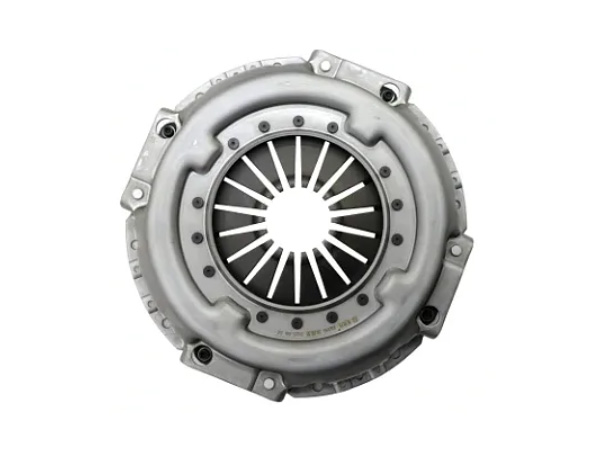
380 Clutch Pressure Plate
Product Details
The 380 clutch pressure plate is a lightweight and cost-effective clutch cover assembly designed for small and light-duty commercial vehicles. Named after its 380-millimeter friction diameter, it is widely applied in light trucks, mini cargo trucks, small vans, agricultural transport vehicles and low-power engineering auxiliary equipment. As the most basic and universal clutch specification in the aftermarket, the 380 pressure plate is perfectly matched with low-horsepower engines, focusing on stable daily power transmission, sensitive clutch response and economical replacement cost. Compared with larger 395, 420 and 430 heavy-duty clutch assemblies, the 380 model features a compact structure, lightweight design and low load adaptation, making it the ideal solution for urban distribution, short-distance cargo transportation and light-duty rural vehicle operation.
A complete 380 clutch pressure plate assembly consists of a high-rigidity stamped clutch cover, precision-ground cast iron pressure plate, high-elastic diaphragm spring, flexible drive straps and anti-fatigue locking rivets. The clutch cover adopts integrated stamping technology with high-quality steel plates, ensuring stable structural rigidity and strong vibration resistance during long-term daily driving. The pressure plate’s working surface is made of high-density wear-resistant cast iron and processed through ultra-precise flat grinding to achieve excellent flatness. This manufacturing standard guarantees full and uniform contact with the clutch disc, effectively avoiding partial wear, unstable friction and power jitter. The built-in diaphragm spring is made of high-purity chromium-vanadium spring steel with stable elastic performance, providing consistent and gentle clamping force. Both push-type and pull-type versions are available to fit JMC, Isuzu, Foton, Dongfeng and most mainstream light truck and mini truck models.
The working principle of the 380 clutch pressure plate is simple, stable and highly efficient. When the clutch pedal is released, the diaphragm spring returns to its original arc shape and produces even axial pressure, firmly clamping the clutch disc between the pressure plate and engine flywheel. Stable friction torque is transmitted to the gearbox, ensuring smooth vehicle startup, acceleration and steady cruising under light-load conditions. When the driver steps down the clutch pedal, the release bearing acts on the diaphragm spring fingers, changing the spring’s pressure angle and lifting the pressure plate away from the friction disc. The power transmission is immediately disconnected, allowing smooth, impact-free gear shifting. With a compact 380mm friction area, the assembly achieves perfect balance between lightweight structure and basic heat dissipation, effectively preventing overheating and slipping during frequent urban start-stop driving.
Manufactured in accordance with standard IATF16949 automotive quality systems, the 380 clutch pressure plate adopts high-quality standardized raw materials. The clutch cover uses high-strength structural steel with strong anti-vibration and anti-deformation performance. The pressure plate is made of thermally stable alloy cast iron that resists high-temperature friction and abrasion. The diaphragm spring is forged from premium 51CrV4 spring steel, treated with professional quenching, tempering and shot peening processes to eliminate internal stress, improve elasticity stability and extend fatigue service life. The complete production process includes precision cutting, hot forming, stress relief treatment, surface fine grinding, dynamic balance calibration and electrophoretic anti-rust coating, ensuring consistent quality and long service life for aftermarket replacement.
The 380 clutch pressure plate has outstanding practical advantages for light-duty vehicle applications. It features light pedal force and flexible operation, bringing comfortable driving experience and sensitive clutch control. Its optimized structural design provides reliable heat dissipation under daily light-load conditions, effectively reducing common faults such as clutch overheating, slipping and friction plate wear. With a mature and simple structure, it has a very low failure rate, convenient installation and strong part interchangeability. Most importantly, it offers excellent cost performance, greatly reducing daily maintenance and replacement costs for light truck fleets, individual drivers and repair workshops.
Widely applicable to light cargo trucks, mini transport vehicles, urban logistics distribution cars, agricultural transporters and municipal maintenance vehicles, the 380 clutch pressure plate is the most mainstream general-purpose clutch accessory in the light-duty vehicle aftermarket. It delivers stable, reliable and durable power transmission performance for daily short-distance transportation and conventional road conditions, becoming the preferred cost-effective replacement part for global light commercial vehicle chassis maintenance.
BLOGS
-
How to Choose the Right Leaf Sp
2026-07-10 06:01:42Discover how to choose the right leaf spring for your heavy duty truck. Learn about load capacity, material types, and what to look for in a reliable leaf spring supplier....
MORE + -
Common Leaf Spring Problems and
2026-07-07 05:01:56Identify and resolve common leaf spring problems in fleet vehicles. Expert guide to diagnosing failures and implementing effective replacement solutions for commercial trucks....
MORE + -
Understanding Clutch Pressure P
2026-07-03 03:45:25Learn how the clutch pressure plate works and identify the signs that indicate it needs replacement. Expert guide for mechanics and vehicle owners on pressure plate diagnosis and selection....
MORE + -
Why do heavy vehicles need thic
2026-06-16 11:13:11Heavy-duty trucks, semi-trailer tractors and construction machinery operate under continuous high torque, heavy loads and frequent start-stop conditions, which generate severe mechanical pressure and thermal shock on clut...
MORE +