 Current Location:
Leaf Spring
Clutch Plate
Clutch Pressure Plate
Oil Filter
Battery Clamp
Motorcycle Parts
Hydraulic Fittings
Brake Rotor
Copper Battery Post Connector
Product Details
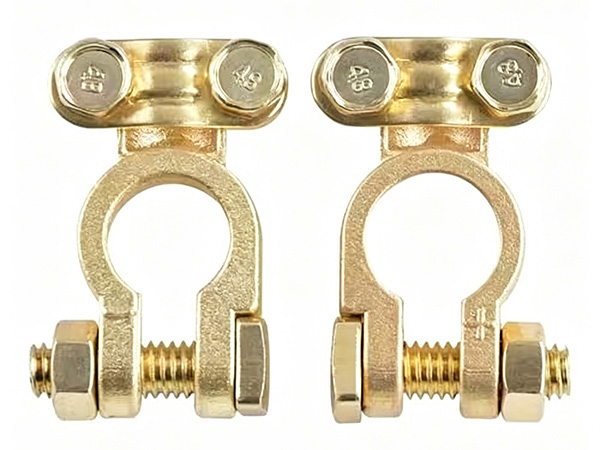
Copper battery post connector is a vital heavy-current conductive fitting used to connect battery poles, thick power cables, starters, inverters and distribution equipment. Widely matched with automobiles, trucks, motorcycles, yachts, RVs and solar energy storage systems, this component builds a stable conductive loop between batteries and electrical loads. Ordinary iron or alloy connectors suffer severe oxidation, high contact resistance and overheating after long-term use, while pure copper battery post connectors deliver excellent electrical conductivity and outstanding durability, effectively avoiding power loss, hard starting, voltage drop and even circuit fire risks brought by inferior terminals. Our factory supplies complete series of copper battery post connectors for aftermarket replacement, vehicle modification and marine electrical assembly, with precise size matching, strong clamping force and reliable anti-corrosion performance.
The core raw material of our connectors is high-purity electrolytic copper, which boasts ultra-low resistivity and superior current-carrying capacity. Compared with brass or iron alternatives, pure copper can transmit large starting current instantly without obvious temperature rise when igniting engines or driving high-power electrical devices. For products serving coastal vessels and humid outdoor environments, we provide full tin-plated copper versions. Uniform tin coating fully covers every contact surface to isolate salt mist, rainwater and humid air, preventing copper from generating green patina that increases resistance. The non-plated raw copper type is ideal for dry inland vehicle fleets, with low cost and stable conductive performance for daily trucks and passenger cars.
Structural design is optimized for easy installation and firm locking. Each copper battery post connector adopts split clamp structure with thickened copper main body, equipped with high-strength locking bolts and wear-resistant gaskets. After tightening the bolt, the inner arc surface closely fits the battery pole, achieving full-surface contact without gaps. This design eliminates loose connection caused by vehicle vibration during long-distance driving or bumpy marine navigation. We offer multiple mainstream specifications to fit standard positive and negative battery posts, including small sizes for motorcycles and compact cars, medium sizes for sedans and SUVs, and heavy-duty thickened types for light trucks, engineering vehicles and marine storage batteries. Matching cable barrels are integrated on the connector body, compatible with different AWG gauge wires for convenient crimping of thick battery cables.
Every finished copper battery post connector undergoes strict standardized quality inspection. Testing items include high-current temperature rise test, salt spray anti-corrosion test, vibration fatigue test and clamping tensile strength test. Under continuous engine vibration and frequent start-stop cycles, the clamping structure will not loosen or deform, maintaining stable conductive contact all year round. All edges are smoothly polished without burrs, preventing scratch damage to battery shells and cable insulation layers during installation. Complete supporting accessories are delivered together with each product set, including lock washers, flat gaskets and fixing screws, so repair shops and modification factories can finish assembly without purchasing extra fittings separately.
Our copper battery post connectors cover a wide range of application scenarios, including family vehicles, logistics fleets, fishing boats, yachts, campers and off-grid solar power systems. Flexible supply modes are available, including retail small packages and bulk carton wholesale for distributors. We support OEM customized services such as laser brand marking, customized clamp sizes and surface plating processes. With premium copper material, tight fit structure and long service life, our battery post connectors provide safe and stable high-current connection solutions for global auto parts wholesalers, marine hardware dealers and vehicle maintenance stores, greatly reducing electrical failure maintenance costs for all types of vehicles and equipment.
BLOGS
-
How to Choose the Right Leaf Sp
2026-07-10 06:01:42Discover how to choose the right leaf spring for your heavy duty truck. Learn about load capacity, material types, and what to look for in a reliable leaf spring supplier....
MORE + -
Common Leaf Spring Problems and
2026-07-07 05:01:56Identify and resolve common leaf spring problems in fleet vehicles. Expert guide to diagnosing failures and implementing effective replacement solutions for commercial trucks....
MORE + -
Understanding Clutch Pressure P
2026-07-03 03:45:25Learn how the clutch pressure plate works and identify the signs that indicate it needs replacement. Expert guide for mechanics and vehicle owners on pressure plate diagnosis and selection....
MORE + -
Why do heavy vehicles need thic
2026-06-16 11:13:11Heavy-duty trucks, semi-trailer tractors and construction machinery operate under continuous high torque, heavy loads and frequent start-stop conditions, which generate severe mechanical pressure and thermal shock on clut...
MORE +