Current Location:
How does leaf spring reduce vehicle bumping?
2026-06-16Leaf springs act as the core elastic buffer component of commercial vehicle suspensions. They mitigate bumpiness generated by uneven roads through elastic deformation, layered energy dissipation, and coordination with shock absorbers. The whole shock-absorbing mechanism can be split into elastic buffering, friction damping, and system collaborative vibration suppression, as explained below.
1. Elastic deformation absorbs vertical impact energy
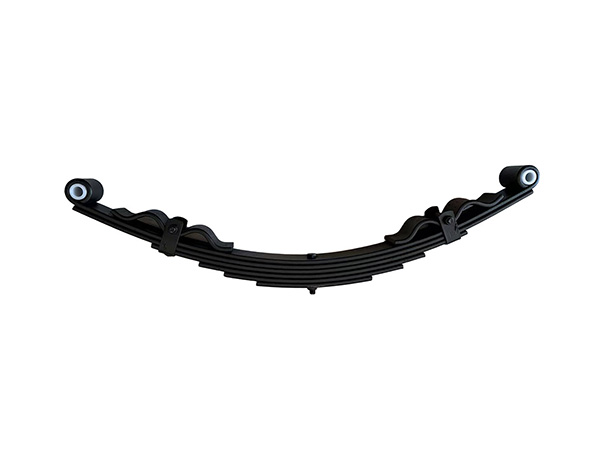
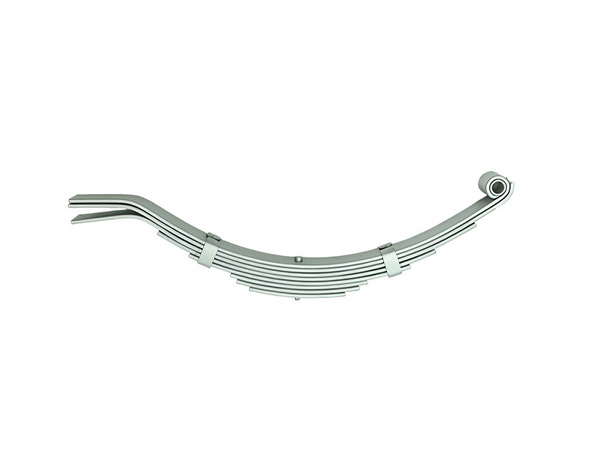
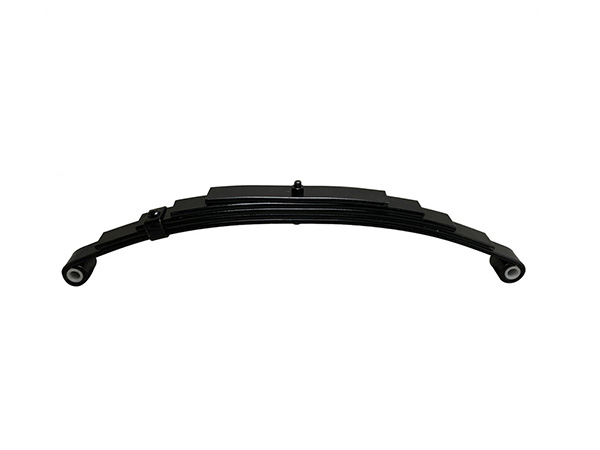
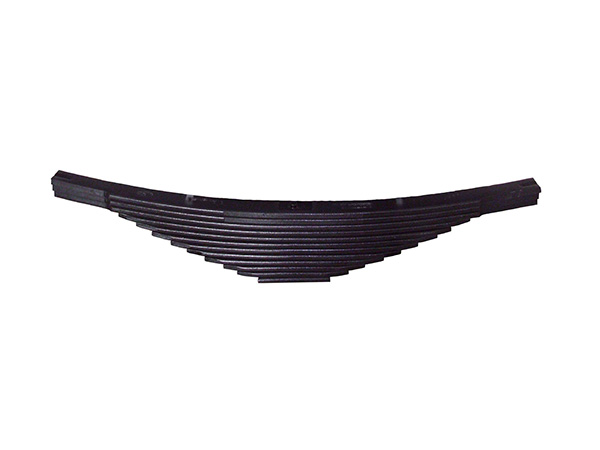
Every leaf spring is manufactured with a preset upward arch and specific elastic stiffness made of high-toughness alloy spring steel.
When wheels roll over speed bumps, pits, or uneven pavement, the road surface delivers upward instantaneous impact force to the axle. The leaf spring is squeezed and flattens slightly, converting the rigid impact kinetic energy into elastic potential energy inside the steel plates. Instead of transmitting violent jolts directly to the chassis and cargo, the spring stretches and compresses gradually to buffer sudden vertical shocks.
After passing the bump, the spring rebounds to its original arch shape and releases stored energy gently, smoothing out abrupt up-and-down body movements.
Parabolic leaf springs: Uniform variable cross-section brings linear soft elasticity, which disperses impact more evenly for superior ride smoothness on highways.
Multi-leaf leaf springs: Higher rigidity for heavy loads, providing stable support while still absorbing large impact energy from mine rough roads.
2. Inter-leaf sliding friction consumes residual vibration energy
This is a unique built-in damping feature of multi-leaf spring assemblies.
A multi-leaf spring consists of multiple stacked steel leaves with anti-wear gaskets and lubricant between layers. During compression and rebound, adjacent leaves slide slightly against one another. Relative sliding creates internal friction that consumes part of the vibration energy as heat, suppressing repeated body bouncing after hitting a bump.
Without this friction, the vehicle would keep bouncing up and down many times after crossing a pit.
Parabolic springs with only 1–2 leaves have almost no inter-leaf friction, so they rely more on external shock absorbers for vibration attenuation.
3. Reasonable structural stiffness restricts excessive body displacement
Leaf spring stiffness is calibrated to match the vehicle’s axle load:
Light-load parabolic springs adopt soft stiffness to minimize bump transmission for empty or standard loaded trucks;
Heavy-duty multi-leaf springs use higher rigidity to avoid excessive chassis sinking and large-amplitude bouncing under full cargo weight.
If elasticity is too soft, the body will sink drastically and bump violently on uneven roads under load; if overly rigid, impact force transfers directly to the cab. The factory-matched spring stiffness balances buffer capacity and support performance to limit the vertical moving range of the frame and reduce bump intensity.
4. Spring eye and shackle swing design releases horizontal displacement
When the spring compresses vertically, its total horizontal length changes. The hinged shackle structure at one end of the leaf spring allows free horizontal swing of the spring eye, eliminating lateral tension stress during deformation.
This flexible connection avoids rigid locking of the spring. If horizontal movement were restricted, vertical compression would be blocked, and road bump impact could not be fully absorbed, leading to harsher jolting of the whole vehicle.
5. Synergistic cooperation with shock absorbers to eliminate residual bounce
Leaf springs alone cannot fully suppress continuous oscillation. The spring stores impact energy but tends to rebound repeatedly. Shock absorbers work with leaf springs to dissipate leftover vibration energy rapidly:
Leaf spring absorbs initial road bump impact via elastic deformation;
Shock absorbers restrain the spring’s rebound stroke and dampen secondary up-down oscillation;
Together, they stop repeated bouncing in one to two cycles, greatly improving smoothness and reducing continuous bumping during driving.
6. Wide uniform stress distribution avoids local rigid shock
Qualified leaf springs pass complete quenching, tempering and shot peening treatment, so bending stress distributes evenly along the entire leaf length, rather than concentrating on a single small section.
Localized stress concentration would create hard rigid points that transmit sharp shocks directly to the frame. Even stress distribution ensures gradual and uniform deformation across the whole spring assembly for softer bump absorption.
Summary of the working logic
Road unevenness creates vertical impact → leaf spring compresses elastically to absorb instantaneous shock energy; inter-leaf friction consumes partial vibration heat energy; shackle hinge releases horizontal deformation displacement to avoid rigid locking; matched stiffness limits oversize body movement; shock absorbers suppress repeated rebound bounce. Combined, these effects drastically reduce vehicle bumping and improve driving comfort while protecting cargo and chassis components.
1. APA 7th Edition
Zhang, L. (2026). Vibration buffering mechanism and bump reduction principle of commercial vehicle leaf spring suspension. Vehicle Ride Comfort Optimization Technology, 2(1), 193–200.
2. MLA 9th Edition
Zhang, Lei. "Vibration Buffering Mechanism and Bump Reduction Principle of Commercial Vehicle Leaf Spring Suspension." Vehicle Ride Comfort Optimization Technology, vol. 2, no. 1, 2026, pp. 193–200.
3. GBT 7714-2015
Zhang Lei. Vibration Reduction Mechanism and Bump Reduction Principle of Commercial Vehicle Steel Plate Spring Suspension [J]. Vehicle Ride Smoothness Optimization Technology, 2026, 2 (1): 193-200