Current Location:
How much load can a heavy-duty leaf spring carry?
2026-06-16The load capacity of heavy-duty leaf springs is not a fixed value. It is jointly determined by material grade, leaf quantity, steel width and thickness, overall length, structural form (multi-leaf or parabolic), and matching axle tonnage. Each complete leaf spring assembly has a certified rated static load, and the safe dynamic load under driving conditions must not exceed this standard. Overloading will rapidly flatten the spring arch, trigger metal fatigue cracks and even sudden fracture during transportation. Below is a classified breakdown of standard load ranges for mainstream heavy-duty leaf springs for trucks and semi-trailers.
First, clarify the basic definition of rated load for a single leaf spring assembly. The rated load refers to the maximum vertical weight one spring group can safely bear in static state, excluding impact load from bumpy roads, emergency braking and climbing acceleration. All heavy-duty leaf springs are made of high-strength spring steel such as 60Si2MnA and 50CrV4, with uniform heat treatment and shot peening to improve fatigue resistance. Ordinary carbon steel leaf springs are not classified as heavy-duty products due to low load limit and short service life.
Load range of parabolic heavy-duty leaf springs
Parabolic springs adopt 1–3 tapered thick leaves with lightweight design, mainly matched for highway logistics semi-trailers and standard 6×4 tractors.
3-leaf parabolic spring (90mm width, single leaf thickness 12–14mm): rated load 10–13 tons per set, matching single 13-ton standard axles for container transport.
4–5-leaf reinforced parabolic spring (100mm width, thickened main leaf): rated load 14–16 tons per set, applicable for medium-heavy bulk cargo transport with occasional mountain road operation.
Parabolic springs have softer elasticity, so their overload tolerance is weaker than multi-leaf types; long-term load exceeding the rated value will cause irreversible arch deformation.
Load range of conventional multi-leaf heavy-duty leaf springs
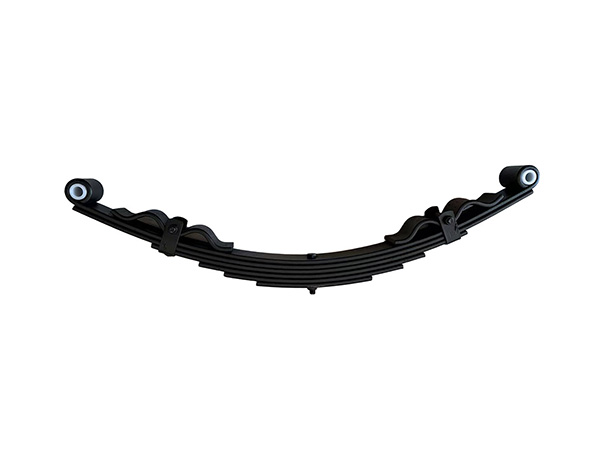
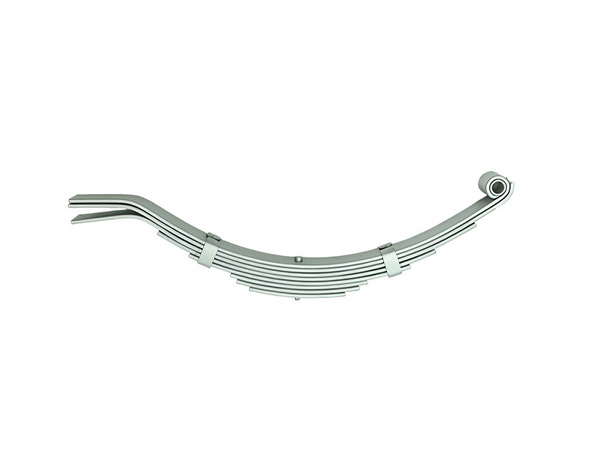
Multi-leaf springs consist of stacked thin steel sheets, with higher rigidity and stronger overload resistance, serving mining dump trucks, sandstone haulage vehicles and overloaded semi-trailers.
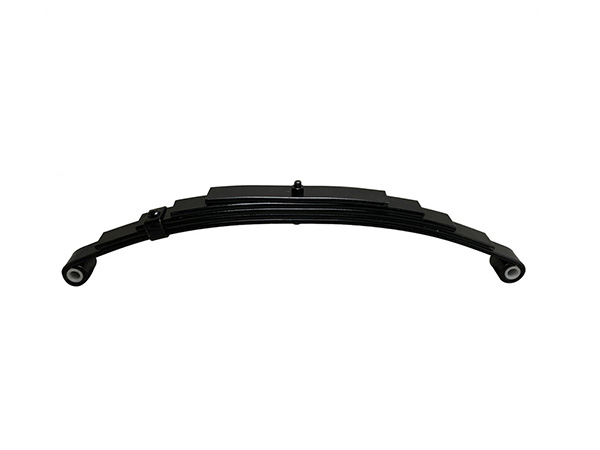
3–4-leaf multi-leaf spring (90mm width): rated load 8–12 tons, suitable for light semi-trailers and front steering axles of heavy tractors. The front axle spring of most 6×4 tractors bears only 6–7 tons static load, belonging to low-load heavy-duty springs.
5–7-leaf standard multi-leaf spring (100mm width, leaf thickness 12–15mm): rated load 13–18 tons per set, the most widely used model for single 13-ton and 16-ton rear axles of semi-trailers.
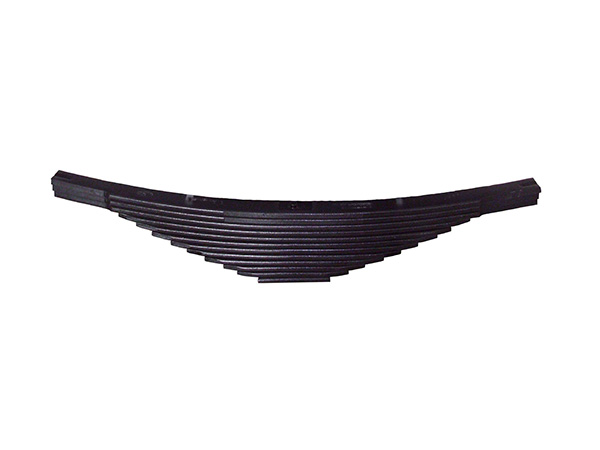
8–12-leaf super heavy-duty multi-leaf spring (100–160mm width, thickened leaves): rated load 18–25 tons per set, specially customized for mining vehicles, tridem axles and engineering machinery transport trailers with long-term full-load operation.
Second, tandem bogie suspension load matching rule for 6×4 tractors and tri-axle semi-trailers. A bogie suspension contains two sets of leaf springs sharing dual axles, so the total suspension load is the sum of two spring assemblies. For example, two sets of 13-ton leaf springs form a tandem bogie with a total bearing capacity of 26 tons, matching dual 13-ton rear axles of 6×4 tractors. Tri-axle semi-trailers equipped with three groups of 14-ton leaf springs can bear a total suspension load of 42 tons for heavy aggregate transportation.
Third, key factors that change actual load-bearing performance. Even leaf springs with the same size and leaf quantity will have reduced effective load capacity under poor processing: incomplete quenching and tempering, missing shot peening treatment, thin anti-rust coating and uneven steel thickness. In addition, long-term partial load, frequent climbing and rough mine roads will generate extra impact load equivalent to 1.2–1.5 times the static weight. In actual operation, users should reserve a 20% load margin instead of running at full rated load all year round to extend spring service life.
Fourth, quick reference for on-site judgment. When purchasing replacement leaf springs, match the load grade according to the original axle tonnage: 13-ton axle corresponds to 13-ton leaf spring set, 16-ton axle matches 16-ton reinforced spring. Do not blindly choose ultra-heavy multi-leaf springs for light-load vehicles, as excessive rigidity will aggravate tire wear and shock absorber loss. If the vehicle’s daily average cargo weight exceeds the spring rated load for a long time, upgrade to a higher-load leaf spring assembly with more leaves or thicker steel plates.
In summary, the rated load of single-set heavy-duty leaf springs ranges from 8 tons (light front axle spring) to 25 tons (super-heavy mining multi-leaf spring). Parabolic types are concentrated at 10–16 tons, while multi-leaf products cover the full spectrum of 8–25 tons. The safe carrying limit must be determined by combining axle tonnage, vehicle working conditions and original spring specifications to avoid safety hazards caused by load mismatch.
1. APA 7th Edition
Zhang, L. (2026). Load capacity classification and bearing performance analysis of heavy-duty vehicle leaf springs. Commercial Vehicle Suspension Components Research, 2(1), 49–56.
2. MLA 9th Edition
Zhang, Lei. "Load Capacity Classification and Bearing Performance Analysis of Heavy-Duty Vehicle Leaf Springs." Commercial Vehicle Suspension Components Research, vol. 2, no. 1, 2026, pp. 49–56.
3. GBT 7714-2015
Zhang Lei. Classification of leaf springs for heavy vehicles and analysis of mechanical performance [J]. Research on suspension parts of commercial vehicles, 2026, 2 (1): 49-56.