Current Location:
How to improve leaf spring load resistance?
2026-06-16Improving the load resistance of leaf springs targets boosting structural rigidity, anti-fatigue capacity and overload tolerance, which can be realized through raw material upgrading, structural optimization, complete heat treatment, matched accessory configuration and standardized operation management. These methods apply to new spring customization and on-vehicle reinforcement transformation for existing fleets, effectively preventing sagging, cracking and premature failure under heavy load, mountain climbing and mine impact conditions. Detailed feasible measures are sorted as follows.
1. Upgrade high-strength alloy spring steel raw materials
Material performance is the fundamental factor determining load bearing limit.
Replace conventional 60Si2Mn silicon-manganese steel with premium 50CrV4 chromium-vanadium spring steel. The addition of Cr and V elements optimizes internal metal grain structure, raising tensile strength above 1500 MPa, enhancing high-temperature resistance and impact toughness, and improving overload resistance by more than 30%.
Strictly control steel plate thickness tolerance; select thickened blank raw materials to reserve enough cross-section bearing area, avoid thin steel plates with insufficient load margin.
Eliminate low-cost carbon steel and inferior recycled spring steel completely, which cannot sustain long-term full-load bending deformation.
2. Optimize leaf spring structural design to increase bearing cross-section
(1) Multi-leaf spring reinforcement schemes
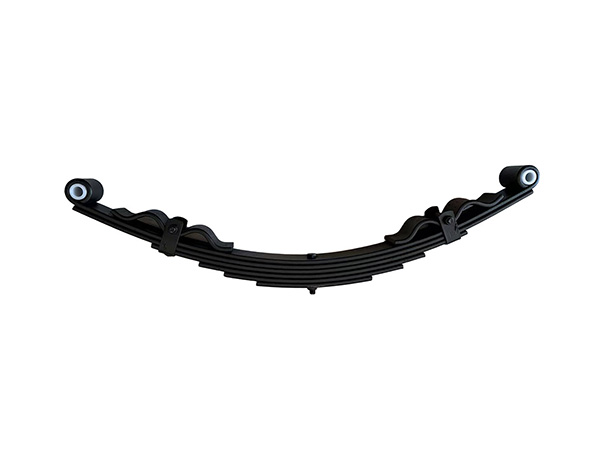
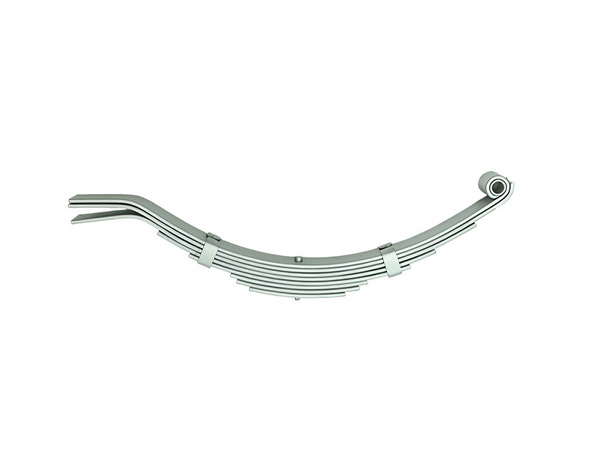
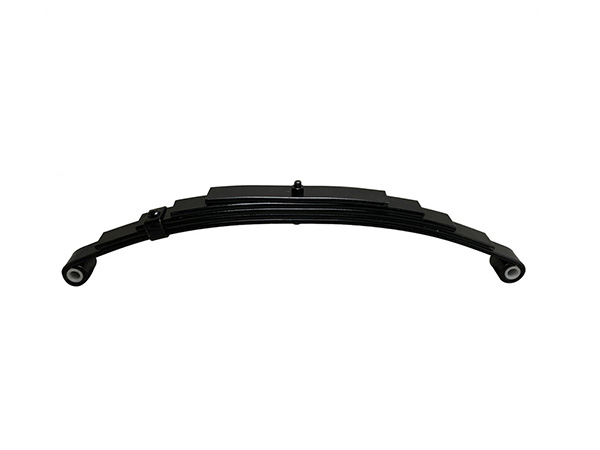
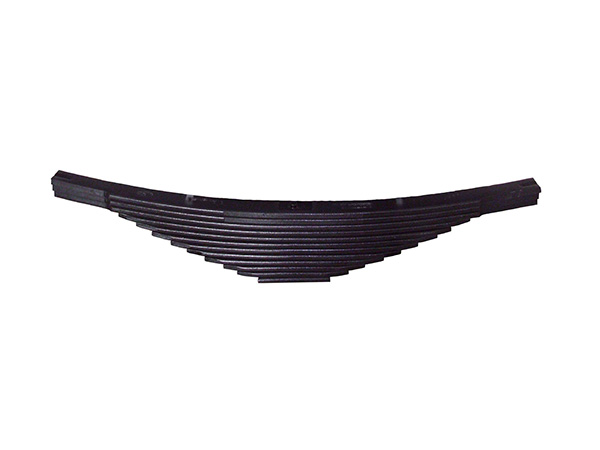
Increase leaf quantity: Upgrade from 3–5 leaf standard versions to 7–12 leaf super heavy-duty stacks, disperse single-sheet bearing pressure through more superimposed steel plates, reduce stress concentration of each leaf under overload.
Widen and thicken single leaf: Expand steel width from standard 90 mm to 100–120 mm, raise single leaf thickness from 10–12 mm to 14–16 mm, significantly enlarge the total bearing cross-sectional area.
Reinforce main leaf and spring eye: Forge thickened main leaf lugs, increase eye wall thickness, add secondary auxiliary main leaves to share maximum bending stress at the spring eye (the most prone fracture position under heavy load).
(2) Parabolic spring reinforcement schemes
Adopt double/triple thickened tapered parabolic leaves instead of single thin parabolic leaf, enlarge the variable cross-section bearing range.
Customize reinforced heavy-duty parabolic molds with larger transition thickness at both ends of the leaf to avoid rapid stress attenuation under overload compression.
(3) Increase free arch height reserve
Design larger original free arch during production, reserving sufficient compression allowance for full-load deformation, prevent irreversible arch flattening after repeated heavy-load compression.
3. Standardize full-process high-standard heat treatment
Even high-grade steel loses load resistance without complete heat treatment; full strengthening procedures must be implemented:
Normalize steel blanks to refine grains and eliminate rolling internal stress;
Precise hot bending forming to lock stable arch without rebound under load;
Strict integral quenching + medium-temperature tempering with accurate temperature control, balance high hardness and impact toughness, avoid brittleness or insufficient elasticity;
Intensive double shot peening: Strengthen surface compressive stress layer depth to 0.2–0.3 mm, restrain fatigue crack expansion under cyclic overload impact; mining springs require enhanced shot blasting intensity;
Secondary low-temperature stress relief tempering after shot peening to stabilize surface strengthening effect.
Skip any heat treatment step will sharply reduce overload tolerance and make springs sag and crack quickly under heavy cargo.
4. Install matched reinforced supporting accessories
A single spring cannot bear overload independently; supporting parts must be upgraded synchronously to avoid local stress overload:
Replace ordinary thin U-bolts with thickened high-strength alloy U-bolts, ensure uniform clamping force for thickened multi-leaf stacks, prevent spring lateral offset and unilateral stress concentration;
Equip heavy-duty thick rubber bushings and reinforced shackle assemblies to reduce metal impact friction at spring eyes under heavy load;
Add thick inter-leaf nylon anti-wear gaskets to avoid steel-on-steel abrasion thinning leaf plates and weakening load capacity;
Install thickened frame rubber limit blocks to prevent main leaf rigid collision with frame under extreme overload compression.
5. Post-assembly auxiliary reinforcement modification for in-use vehicles
For existing vehicles that need higher load resistance without replacing the whole spring assembly:
Add auxiliary booster leaf springs between original spring and axle seat; extra leaf shares partial vertical load to lower single spring stress;
Replace worn thin auxiliary leaves with new thickened leaves of identical material to restore overall stack rigidity;
Retighten U-bolts with standard torque regularly every 5,000 km, prevent loose clamping leading to unilateral overload;
Clean rust and apply high-temperature lubricant between leaves to reduce abrasion thinning and maintain original bearing cross-section.
6. Standardize vehicle operation and maintenance to retain load resistance performance
Even fully reinforced springs will lose load capacity rapidly with improper use:
Strictly control cargo load within the spring rated load, reserve 10%–20% safety margin for mine and mountain transport, avoid chronic overload plastic sagging;
Distribute cargo evenly to prevent unilateral partial load causing asymmetric spring fatigue deformation;
Slow down on bumpy mine and mountain roads, reduce instantaneous impact load far exceeding static rated load;
Regular anti-rust coating maintenance to eliminate rust pits (stress concentration points) that reduce fatigue bearing capacity;
Replace cracked, thinned and severely sagged single leaves timely to avoid uneven force sharing of the whole spring stack.
7. Customize load-matched spring specification according to axle tonnage
When ordering new leaf springs, select products with rated load equal to or higher than the supporting axle tonnage, instead of matching low-load light versions to save costs. For dual bogie axles of 6×4 tractors and tri-axle semi-trailers, calculate total balanced load reasonably and configure corresponding heavy-duty spring sets to avoid overloading single spring groups.
In summary, the systematic ways to improve leaf spring load resistance cover seven dimensions: upgrading high-strength alloy steel raw materials, widening/thickening and increasing leaf quantity for structural reinforcement, implementing full high-standard heat treatment, matching heavy-duty supporting accessories, installing auxiliary booster leaves for existing vehicles, standardizing load control and daily anti-rust maintenance, and selecting load-grade matched springs according to axle tonnage. Combined application of these measures can greatly enhance overload resistance, extend service life and eliminate spring fracture safety hazards under heavy transport conditions.
Google Scholar Citation Formats
1. APA 7th Edition
Zhang, L. (2026). Systematic optimization methods to improve heavy-load bearing performance of commercial vehicle leaf springs. Heavy-Duty Suspension Component Optimization Technology, 2(1), 185–192.
2. MLA 9th Edition
Zhang, Lei. "Systematic Optimization Methods to Improve Heavy-Load Bearing Performance of Commercial Vehicle Leaf Springs." Heavy-Duty Suspension Component Optimization Technology, vol. 2, no. 1, 2026, pp. 185–192.
3. GBT 7714-2015
Zhang Lei. Systematic optimization method for improving the heavy-duty load-bearing performance of commercial vehicle steel plate springs [J]. Optimization Technology of Heavy duty Suspension Components, 2026, 2 (1): 185-192