 Current Location:
Leaf Spring
Clutch Plate
Clutch Pressure Plate
Oil Filter
Battery Clamp
Motorcycle Parts
Hydraulic Fittings
Brake Rotor
Suspension Leaf Spring
Product Details
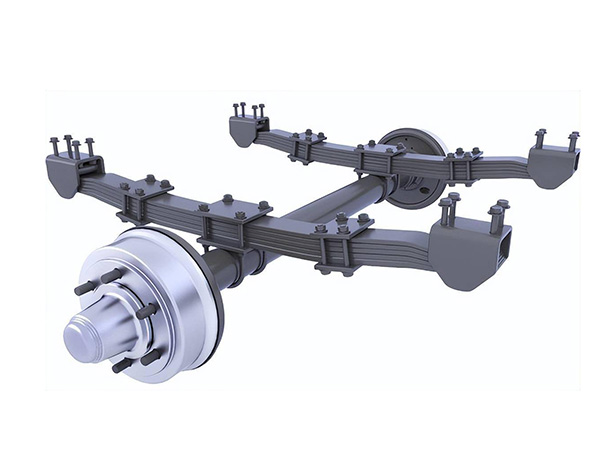
Suspension leaf spring is one of the most fundamental, reliable, and widely applied elastic suspension components in the automotive and commercial vehicle industry. Also known as a laminated spring or carriage spring, it consists of multiple layers of high-strength steel plates stacked in a graduated arc shape. As a core part of mechanical suspension systems, it is installed between the vehicle frame and axle, undertaking the dual functions of load bearing and vibration damping. Thanks to its simple structure, superior rigidity, and excellent durability, the leaf spring has been universally adopted in trucks, pickups, trailers, buses, light commercial vehicles, and off-road vehicles, remaining an irreplaceable solution for heavy-duty suspension systems.
The basic structure of a suspension leaf spring includes a main leaf, auxiliary leaves, center bolt, spring clips, rubber bushings, and interleaf cushions. The longest main leaf features rolled eyes at both ends, which connect to frame hangers and shackles to ensure flexible movement during compression and rebound. Multiple shorter auxiliary leaves are layered underneath to progressively increase stiffness and load capacity. The center bolt tightly locks all steel layers to prevent sliding and misalignment, while spring clips keep the leaf pack integrated under continuous road impact. Rubber bushings and spacer pads effectively reduce metal-to-metal friction, eliminate squeaking noise, and minimize wear, significantly improving driving smoothness and component service life.
The working mechanism of the leaf spring is based on elastic deformation and energy absorption. When a vehicle travels on uneven, bumpy, or rough road surfaces, vertical impact forces from the wheels are transferred upward to the axle and leaf spring assembly. The stacked steel plates flex and bend elastically to absorb vibration and cushion sudden shocks. After the external pressure is released, the high-toughness spring steel automatically recovers its original camber. Beyond shock absorption, the leaf spring also provides stable axle positioning, restricts lateral movement, reduces body roll, and controls axle wrap during acceleration and braking. This unique integration of load-bearing and positioning functions makes the leaf spring far more stable than many other suspension structures for heavy-load scenarios.
High-quality suspension leaf springs are manufactured from premium alloy spring steel such as 60Si2Mn and 51CrV4, materials recognized for high tensile strength, outstanding fatigue resistance, and strong impact toughness. The entire manufacturing process is strictly standardized, including precision blanking, hot forming, camber calibration, quenching and tempering heat treatment, shot peening, and multi-layer anti-rust coating. Heat treatment enhances the overall mechanical performance of the steel, ensuring stable elasticity under repeated bending cycles. Shot peening strengthens the spring surface, eliminates internal stress, and greatly extends fatigue life. Electrophoretic and epoxy surface coatings provide excellent resistance against rust, corrosion, salt spray, mud, and extreme weather conditions.
Suspension leaf springs can be categorized into two major types: conventional multi-leaf springs and parabolic leaf springs. Multi-leaf springs feature multiple thin steel layers, delivering high rigidity, strong load capacity, and excellent impact resistance, ideal for heavy-duty commercial vehicles and engineering equipment. Parabolic leaf springs adopt a tapered thickness design with fewer leaves, effectively reducing friction and weight while offering smoother riding comfort, which is widely used for modern light trucks, pickups, and luxury commercial vehicles. Both types support customized lengths, widths, camber heights, and leaf quantities to meet OEM replacement and aftermarket upgrade requirements.
Compared with coil springs and air suspensions, leaf spring suspensions possess prominent advantages including ultra-high reliability, simple assembly, low failure rate, and low maintenance cost. They perform stably under heavy loading, long-distance cruising, off-road driving, and frequent start-stop working conditions. With strong structural stability and wide adaptability, suspension leaf springs continue to be the preferred suspension solution for global commercial transportation, ensuring vehicle safety, cargo protection, and consistent driving performance in diverse and harsh road environments.
BLOGS
-
Organic vs Ceramic Clutch Disc
2026-08-16 09:37:25Compare organic vs ceramic clutch disc materials for your vehicle. Learn the pros and cons of each friction material type and find the right choice for your specific application....
MORE + -
OEM vs Aftermarket Clutch Compo
2026-08-15 07:52:41Compare OEM vs aftermarket clutch components to find the right choice for your vehicle. Understand quality differences, cost considerations, and when each option makes sense....
MORE + -
Understanding Multi-Leaf vs Mon
2026-08-14 06:55:10Learn the differences between multi-leaf and mono-leaf spring designs for commercial vehicles. Compare performance, durability, and application suitability from an expert perspective....
MORE + -
Leaf Spring Material Selection:
2026-08-13 06:43:00Compare carbon steel vs alloy steel for leaf spring manufacturing. Understand material properties, heat treatment, and how steel selection affects spring performance and longevity....
MORE +